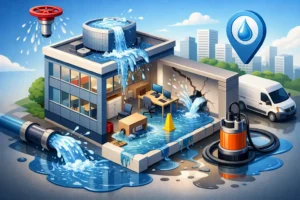
A burst pipe at 2:13 a.m. does not wait for office hours, board approval, or a callback from your regular contractor. If your building team is searching for shut-off locations while water moves into walls, elevators, or occupied units, the damage is already getting worse. That is why after hours property emergency planning matters for homeowners, condo boards, landlords, and commercial operators who need to protect people first and property second.
The difference between a manageable incident and a major loss is usually not the cause. It is the first 30 to 60 minutes. A small supply line failure can become a multi-unit water loss overnight. A sewer backup in one area can turn into a health and safety issue if people are allowed to walk through contaminated spaces. A roof leak during a storm can spread from one ceiling section into insulation, electrical systems, and interior finishes before sunrise.
Good planning is not about creating a thick binder no one reads. It is about making sure the right person can make the right decision, fast, with the right contact information and site knowledge in front of them.
What after hours property emergency planning needs to cover
Most properties think they have a plan because they have an emergency phone number. That is not enough. A workable plan has to cover authority, access, shutdown procedures, safety steps, communications, and vendor response.
Authority comes first. Someone must be clearly authorized to approve emergency work after hours. In residential settings, that may be the homeowner. In a condo, it may be the property manager, superintendent, or an on-call board representative. In a commercial facility, it may be an operations lead, facilities manager, or security supervisor. If nobody knows who can approve extraction, board-up, temporary plumbing, or hazardous cleanup, response slows down and damage spreads.
Access matters just as much. Emergency crews lose valuable time when they cannot reach mechanical rooms, electrical rooms, risers, roof hatches, vacant units, or utility shutoffs. A real plan accounts for keys, lockboxes, alarm instructions, gate access, elevator access, and site contacts who can meet responders without delay.
Shutdown knowledge is another major gap. Every property should know where the main water shutoff is, but larger buildings also need mapped locations for zone valves, sprinkler controls, electrical panels, gas shutoffs, sump systems, and backwater devices. During an emergency, shutting down the entire building may stop damage, but it can also create other problems. In some cases, isolating one section is safer and less disruptive. That is why site-specific information matters.
The risks of improvising after hours
When emergencies happen overnight, people tend to improvise. They call whoever answers, send photos in a group text, and hope the issue can wait until morning. Sometimes that works. Often it does not.
Water is the clearest example. Clean water from a pipe break can quickly move into drywall, flooring, insulation, and cabinetry. If it sits for hours, materials swell, delaminate, and support microbial growth. What could have been a targeted drying job may become demolition and reconstruction.
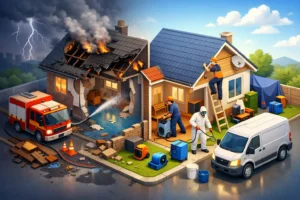
Fire and smoke events create a different kind of risk. Even a contained kitchen or electrical fire can leave corrosive residues, airborne particles, and odor migration throughout a property. Waiting too long to stabilize the site and begin cleanup can make restoration harder and more expensive.
Sewage and biohazard situations leave even less room for delay. These are not basic cleaning issues. They require containment, protective equipment, safe disposal, and disinfection procedures. If after-hours staff are not trained to control access and call the right emergency team immediately, liability increases fast.
The same principle applies to commercial spaces. Overnight flooding in a retail unit, restaurant, office, or warehouse is not just a building problem. It can affect inventory, equipment, tenant operations, customer safety, and reopening timelines.
Build the plan around the first hour
The most effective after hours property emergency planning focuses on the first hour because that is when losses can still be contained.
Start with the event categories most likely to affect your property. For most buildings, that includes water intrusion, burst pipes, sewer backups, plumbing failures, roof leaks, storm damage, fire and smoke, mold-related moisture discoveries, and hazardous contamination events. A high-rise condo may need detailed flood response procedures for risers, drain stacks, and unit-to-unit migration. A detached home may need a simpler plan focused on shutoffs, safe evacuation, and emergency service contact.
For each scenario, define the immediate steps in plain language. Who gets called first. Who attends site. What gets shut down. Which areas must be isolated. When occupants should leave. When emergency restoration, plumbing, roofing, or environmental cleanup must be dispatched immediately instead of deferred.
Keep the instructions practical. During a stressful event, nobody wants to read policy language. They need direct actions they can follow under pressure.
Who should be on your after-hours call chain
A strong call chain prevents confusion and duplicate decisions. It should include internal contacts and external responders, in the exact order they should be used.
For many properties, the chain starts with the person who discovers the issue, then moves to on-site supervision or security, then to the decision-maker authorized to approve emergency work. From there, it should reach a qualified emergency restoration contractor, any necessary specialty trade such as an emergency plumber or roofer, and finally the insurer or broker if required by your reporting process.
There is a trade-off here. A very short call chain speeds action, but it can leave key stakeholders out of the loop. A long call chain may satisfy internal reporting habits, but it slows response. The right balance depends on your property type and governance structure. In most emergency situations, speed should win as long as authority and documentation are clear.
Site information that should never be missing
The best emergency teams work fast, but they work even faster when the property is prepared. Every site should have a current emergency information package that can be accessed after hours.
That package should identify shutoff locations, alarm procedures, utility providers, building layout basics, high-risk areas, and known vulnerabilities such as recurring drain issues, older plumbing sections, low points prone to flooding, or past roof leak zones. It should also note whether any occupants have special access needs or whether the property has sensitive areas like server rooms, medical equipment, archives, or tenant spaces with strict contamination concerns.
This is especially important in condos and commercial properties. A leak above one unit can affect multiple floors. A sewage event in a common area can impact resident safety and elevator use. A pipe failure near electrical infrastructure changes the response priority immediately.
Training matters more than the document
A plan that lives in a folder is not a plan. The people responsible for the property need to know how to use it.
That does not mean everyone needs technical restoration training. It means they need to know how to recognize an emergency, secure the area, limit exposure, and trigger the correct response. Security, maintenance staff, supers, building operators, and designated managers should all understand their role after hours.
Walkthroughs help. So do short scenario drills. If a night guard cannot identify the domestic water shutoff or does not know when a sewage backup requires immediate containment, the written plan will not save time. Repetition will.
Documentation and insurance support
Emergency planning should also account for documentation from the start. Photos, time-stamped notes, who was notified, what was shut down, and when professional responders arrived all help support a cleaner insurance process.
This is where working with a full-service emergency response company can make a real difference. If one team can handle mitigation, specialty trades, contamination control, drying, and claim documentation, you reduce handoffs at the worst possible moment. GTA Restoration is built around that kind of response model because emergencies rarely stay within one trade category.
Still, one size does not fit every property. A single-family home may only need a straightforward emergency contact protocol and shutoff map. A multi-tenant building needs a deeper plan that covers occupant communication, access coordination, life safety, vendor authorization, and business continuity.
Review the plan before the next incident forces you to
The right time to test your emergency plan is not during freezing weather, a holiday weekend, or a midnight sewer backup. Review contacts regularly. Update access instructions. Confirm who can approve after-hours work. Check that shutoff information still matches the site. If your property has changed, your plan should change with it.
After-hours emergencies are stressful by nature, but they do not have to become chaotic. When people know who is in charge, how to secure the property, and how to bring in qualified help without delay, the path from damage to recovery gets much shorter.
The best emergency plan is the one that helps you act decisively before a small overnight problem becomes a major restoration project by morning.
Related