
...
Mold Removal and Mould Remediation Toronto - GTA Restoration

Emergency? 24-Hrs

416.800.0000
  • Home Restore
  • Emergency Services
    • Emergency Plumbers 24/7
    • Water Damage Restoration
    • Flooded Basement
    • Mold Remediation Toronto
    • Sewer Backup Remediation
    • Fire & Smoke Restoration
    • Odour Removal Toronto
    • Biohazard Cleanup
    • Emergency Roofing Repair
    • Water Leak and Detection
    • Condominium Restoration
    • Basement WaterProofing
    • Property Inspection Toronto
    • Sanitizing and Disinfection
    • Insurance Claim Appraisers
    • Equipment for Rent Toronto
    • Privacy Policy & Service Terms
  • Commercial Restoration
  • Blog
  • Our Team
  • Contact
13 August 2026 - Categories:

How to Dry Wet Basement Walls


Disaster Restoration Emergency Plumbing Service Blog Icon

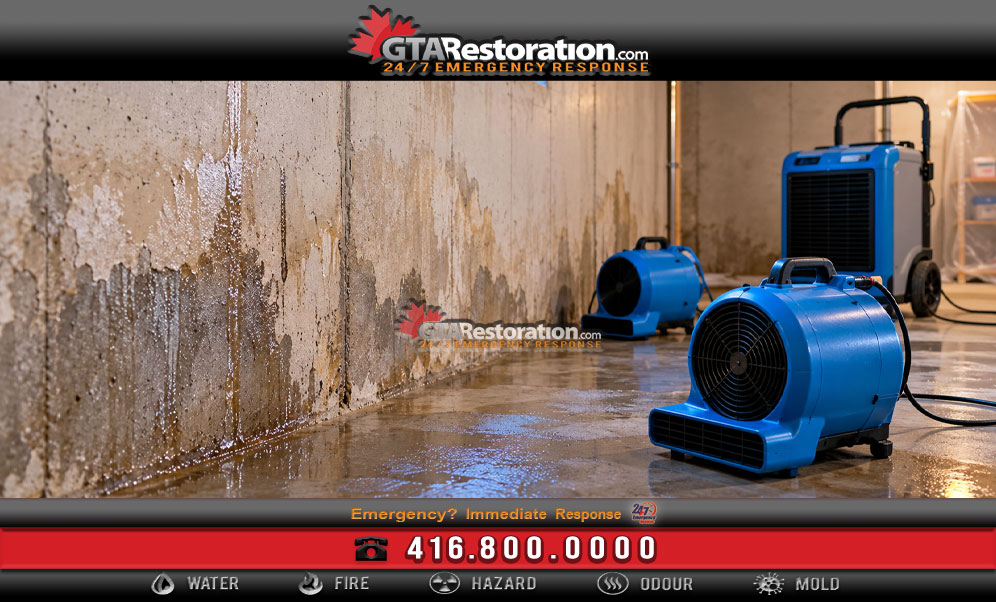
Basement Drying Equipment in Action, How to dry wet basement walls after water damage or flooding

How to Dry Wet Basement Walls

Knowing how to dry wet basement walls can help limit water damage, reduce dampness and lower the chance of mold growth after a leak or basement flood. However, drying the visible surface alone may not remove moisture trapped inside drywall, insulation, wood framing or masonry.

First, find and stop the source of the water. Next, remove standing water and wet contents. Then use air movement, dehumidification and moisture checks to dry affected materials properly.

Stop the Water Before Drying Basement Walls

Before starting the drying process, identify why the basement wall became wet. Common causes include foundation seepage, burst pipes, plumbing leaks, sump pump problems, window leaks and heavy rainfall.

If the water source remains active, drying equipment will have limited effect. Therefore, repair plumbing leaks or address exterior water entry before focusing on the wall itself.

Remove Standing Water First

If water remains on the basement floor, remove it before trying to dry the walls. A wet floor continually adds moisture to the surrounding air and slows the drying process.

For larger floods, professional extraction equipment can remove water more quickly. GTA Restoration provides flooded basement cleanup for properties with significant standing water.

Move Wet Items Away From Basement Walls

Move furniture, boxes and other contents away from damp walls so air can circulate. In addition, remove wet cardboard and other materials that hold moisture.

Health Canada recommends keeping basement storage areas uncluttered and using plastic bins instead of cardboard where dampness is a concern.

Use Fans to Improve Air Movement

Air movement can help moisture leave wet surfaces. Position fans or professional air movers so air travels across affected walls rather than blowing into only one small area.

However, do not use fans to spread air through an area with significant visible mold or contaminated sewage without first assessing the conditions.

Run a Dehumidifier in the Basement

A dehumidifier removes moisture from the air and can help building materials dry more efficiently. Keep basement windows closed while the dehumidifier operates so humid outdoor air does not continually enter the space.

The Health Canada moisture and mould guide recommends using a dehumidifier in damp basements and when indoor relative humidity rises above 50%.

Dry Wet Basement Walls by Material Type

How to Dry Wet Drywall

Drywall absorbs water easily, especially along the bottom edge. If the drywall became wet from a clean-water leak and the damage is limited, professional drying may sometimes save it.

Use moisture readings to determine whether the material continues to hold water. Also, remove baseboards where appropriate so trapped moisture can escape from the lower wall area.

If drywall becomes badly swollen, soft, contaminated or develops mold beneath the painted surface, removal and replacement may provide the safer option.

Drying Basement Concrete and Masonry Walls

Concrete and block walls can absorb and release moisture slowly. Therefore, a wall may remain damp after the visible water disappears.

Increase airflow and run a dehumidifier while monitoring the area. If water continues entering through cracks or the wall remains wet after rainfall, address the foundation or drainage problem instead of repeatedly drying the surface.

Check Insulation Behind Wet Basement Walls

Finished basement walls often contain insulation behind drywall. Water can enter this hidden space and remain there even when the room-facing surface begins to dry.

If insulation becomes heavily wet, compressed or contaminated, technicians may need to open part of the wall for inspection. Moisture trapped inside a closed cavity can slow drying and support mold growth.

Inspect Wood Framing for Moisture

Wood studs and plates can also absorb water. Although they may look dry on the surface, moisture may remain inside the material.

Therefore, technicians often use moisture meters to track drying progress before closing walls or beginning repairs.

Use Moisture Readings, Not Just Touch

Touch alone cannot confirm that a wall has dried. A surface may feel dry while the inside remains damp.

Moisture meters help compare affected areas with known dry materials. Professional restoration work may also use temperature, humidity and other drying measurements to track conditions over time.

The ANSI/IICRC S500 water damage restoration standard covers building materials, drying technology, moisture evaluation and structural restoration after water damage.

Prevent Mold After Drying Wet Basement Walls

Dry Basement Walls as Soon as Possible

Long periods of dampness increase the chance of mold growth. Health Canada notes that mold can begin growing in areas with excessive moisture within about 48 hours.

Therefore, start extraction and drying promptly once the water source is controlled and the area is safe.

Keep Basement Humidity Under Control

After the wall dries, continue monitoring basement humidity. Health Canada recommends maintaining indoor relative humidity between about 30% and 50%.

A hygrometer can help you track the level. If the basement regularly rises above 50%, a dehumidifier or improved ventilation may help.

Check for Hidden Mold

Musty odours, recurring stains or dampness may indicate a hidden moisture problem. Mold can grow behind drywall and above ceilings when water remains inside concealed spaces.

If visible mold or recurring odours appear, GTA Restoration also provides mold inspection and remediation.

Do Not Paint Over a Wet Basement Wall

Paint does not solve an active moisture problem. Painting a damp wall can trap moisture and hide warning signs without correcting the source.

Instead, confirm that the wall has dried and repair the water problem first. Then complete cosmetic repairs once conditions are stable.

When Professional Basement Drying Makes Sense

Professional help may be useful when water has entered wall cavities, insulation or multiple rooms. It can also help after a large flood, sewage backup or repeated foundation leak.

GTA Restoration provides water damage restoration, extraction, moisture inspection and structural drying throughout Toronto and the GTA.

If the water source is difficult to identify, our water leak detection service can help locate wet areas and possible leak sources.

Dry the Wall and Fix the Cause

Ultimately, the best way to dry wet basement walls is to combine moisture removal with source correction. Extraction, airflow and dehumidification may dry the materials, but the problem can return if foundation water, plumbing leaks or high humidity remain.

Use moisture readings whenever possible and avoid closing or repainting the wall too early. Correct drying helps protect finished materials and makes recurring moisture problems easier to prevent.

When significant water damage affects the basement, professional equipment and monitoring can help dry wet basement walls and surrounding materials more completely.


Wet Basement Walls or Hidden Moisture?

GTA Restoration provides water extraction, moisture detection, structural drying and flooded basement cleanup throughout Toronto and the GTA.

Stop the water source first, then dry the affected materials before moisture spreads farther.

Call Us: 416-800-0000

Learn More

Wet Basements and the Risk for Harmful Mold | Water Damage Restoration | Best Dehumidifiers for Water Damage | How to Dry Basement Walls After Water Damage | Emergency Flooding in Basement
Share this... Spread the word!


Tags:

☛ ☛ Related Restoration Articles You May Also Like!

Emergency? Immediate response 24/7

416.800.0000 416.800.0000

For non-emergencies use our contact form
Stop the Basement Water Source

Before drying walls, identify the leak, seepage or flooding source. Fixing the cause prevents new moisture from entering while drying equipment operates.

Remove Standing Water

Extract water from the floor first. Standing water raises basement humidity and makes walls and other materials take longer to dry.

Move Contents Away From Walls

Move furniture, boxes and storage away from damp surfaces. This creates more airflow and gives technicians better access to affected materials.

Use Air Movement

Fans and professional air movers can increase evaporation from wet walls. Position equipment so air reaches the affected surfaces evenly.

Run a Dehumidifier

A dehumidifier removes moisture from basement air. Keep windows closed while it operates so humid outdoor air does not slow the drying process.

Check Wet Drywall

Drywall can hold moisture behind the painted surface. Moisture readings can help determine whether drying may save the material or whether damaged sections need removal.

Dry Concrete and Block Walls

Masonry can release moisture slowly. Continue airflow and dehumidification while correcting any foundation or drainage problem that caused the wall to become wet.

Inspect Hidden Insulation

Water may remain behind finished basement walls. Wet insulation or enclosed wall cavities sometimes require further inspection before repairs begin.

Measure Moisture Levels

Do not rely only on touch. Moisture meters help identify materials that still contain water even when the visible surface feels dry.

Control Basement Humidity

Keep relative humidity under control after drying. A hygrometer and dehumidifier can help prevent the basement from becoming damp again.

Watch for Mold

Musty odours or recurring stains may signal unresolved moisture. Correct the source quickly and inspect hidden areas when the problem returns.

Professional Basement Drying

GTA Restoration provides water extraction, structural drying and moisture monitoring throughout Toronto and the GTA for flooded or water-damaged basements.


Need Help Drying Wet Basement Walls?

Get professional moisture detection, extraction and structural drying before hidden water causes more damage.

Call Us: 416-800-0000


Nationwide, Local Pricing

GTA Restoration offers local flood & water damage repair, mold removal/remediation, asbestos removal/abatement, fire/smoke damage repair services and much more.

Search

  • Ajax Asbestos Removal
  • Ajax Mold Removal
  • Ajax Water Damage
  • Anjou Mold Removal
  • Aurora Mold Removal
  • Aurora Water Damage
  • Beaconsfield Asbestos Removal
  • Beaconsfield Mold Removal
  • Boucherville Mold Removal
  • Brampton Asbestos Removal
  • Brampton Asbestos Removal
  • Brampton Mold Removal
  • Brampton Water Damage
  • Brossard Mold Removal
  • Burlington Asbestos Removal
  • Burlington Mold Removal
  • Burlington Water Damage
  • Burnaby Mold Removal
  • Burst Frozen Pipe Edmonton
  • Caledon Mold Removal
  • Caledon Water Damage
  • Calgary Asbestos Removal
  • Calgary Mold Removal
  • Calgary Water Damage
  • Cambridge Mold Removal
  • Cambridge Water Damage
  • Chambly Mold Removal
  • Chateauguay Mold Removal
  • Chomedey Mold Removal
  • Clarington Mold Removal
  • Concord Mold Removal
  • Concord Water Damage
  • Mississauga Mold Removal
  • Coquitlam Mold Removal
  • Cumberland Mold Removal
  • Dollard-des-Ormeaux Mold Removal
  • Dorval Mold Removal
  • Edmonton Asbestos Removal
  • Edmonton Mold Removal
  • Edmonton Water Damage
  • Etobicoke Asbestos Removal
  • Etobicoke Mold Removal
  • Etobicoke Water Damage
  • McMurray Fire Damage Services
  • Saskatchewan Asbestos Removal
  • Saskatchewan Mold Removal
  • Frozen Burst Pipe Repair Montreal
  • Frozen Burst Pipe Repair Ottawa
  • Gloucester Asbestos Removal
  • Gloucester Mold Removal
  • Hamilton Asbestos Removal
  • Hamilton Asbestos Testing
  • Hamilton Mold Removal
  • Hamilton Water Damage
  • Hampstead Mold Removal
  • Hampstead Water & Flood Damage
  • L'île-Bizard Mold Removal
  • Kahnawake Mold Removal
  • Kanata Asbestos Removal
  • Kanata Mold Removal
  • Kanata Water Damage
  • Kirkland Mold Removal
  • Kitchener Asbestos Removal
  • Kitchener Mold Removal
  • Kitchener Water Damage
  • Lasalle Mold Removal
  • Laval Asbestos Removal
  • Laval Mold Removal
  • Laval Water Damage
  • London Mold Removal
  • London Water Damage
  • Longueuil Mold Removal
  • Longueuil Water Damage
  • Markham Asbestos Removal
  • Markham Mold Removal
  • Markham Water Damage
  • Mississauga Asbestos Testing
  • Mississauga Mold Removal
  • Mississauga Water Damage
  • Montreal Air Duct Cleaning
  • Montreal Asbestos Removal
  • Montreal Asbestos Testing
  • Montreal East Mold Removal
  • Montreal Mold Removal
  • Montreal Water Damage
  • Mount-Royal Mold Removal
  • Nepean Asbestos Removal
  • Nepean Mold Removal
  • Nepean Water Damage
  • New Market Water Damage
  • New Westminster Mold Removal
  • Newmarket Mold Removal
  • North York Mold Removal
  • Oakville Mold Removal
  • Oakville Water Damage
  • Orleans Asbestos Removal
  • Orleans Mold Removal
  • Orleans Water Damage
  • Osgoode Mold Removal
  • Oshawa Mold Removal
  • Oshawa Water Damage
  • Ottawa Air Duct Cleaning
  • Ottawa Asbestos Removal
  • Ottawa Mold Removal
  • Ottawa Vermiculite Removal
  • Ottawa Water Damage
  • Pickering Mold Removal
  • Pickering Water Damage
  • Red Deer Mold Removal
  • Red Deer Water Damage
  • Richmond Hill Mold Removal
  • Richmond Hill Water Damage
  • Richmond Mold Removal
  • Rideau Lakes Mold Removal
  • Rockcliffe Park Mold Removal
  • Roxboro Mold Removal
  • Saint Laurent Mold Removal
  • Saint-Hubert Mold Removal
  • Scarborough Asbestos Removal
  • Scarborough Mold removal
  • Scarborough Water Damage
  • Sewer Backup Edmonton
  • Sewer Backup Montreal
  • Sewer Backup Ottawa
  • Sherwood Park Asbestos Removal
  • Sherwood Park Mold Removal
  • Spruce Grove Asbestos Removal
  • Spruce Grove Mold Removal
  • St. Albert Asbestos Removal
  • St. Albert Mold Removal
  • Ste.Dorothee Mold Removal
  • Surrey Mold Removal
  • Thornhill Mold Removal
  • Toronto & GTA Asbestos Removal
  • Toronto & GTA Mold Removal
  • Toronto Air Duct Cleaning
  • Toronto Water Damage
  • Unionville Mold Removal
  • Unionville Water Damage
  • Vancouver Asbestos Removal
  • Vancouver Mold Removal
  • Vancouver Water Damage
  • Vanier Mold Removal
  • Vaughan Mold Removal
  • Vaughan Water Damage
  • Westmount Mold Removal
  • Whitby Water Damage
  • Woodbridge Asbestos Removal
  • Woodbridge Mold Removal
  • Woodbridge Water Damage
  • Waterproofing
  • Kitchen & Bath Pro
  • Condo Restoration

Main Head Office


Wet Basement Walls – Frequently Asked Questions

What is the fastest way to dry wet basement walls?

Stop the water source, remove standing water, increase airflow, run a dehumidifier and monitor the wall with moisture readings.

Can wet drywall dry without removal?

Sometimes. Clean-water damage may dry successfully when caught early, but swollen, contaminated or mold-damaged drywall may need removal.

Should I open basement windows while using a dehumidifier?

Usually no. Keep windows closed while the dehumidifier runs so humid outdoor air does not continually enter the basement.

How do I know when a basement wall is dry?

Use moisture readings rather than touch alone. A surface may feel dry even while the wall cavity or material still contains moisture.

Can wet basement walls cause mold?

Yes. Prolonged moisture can support mold growth, so fix the water source and dry affected materials as soon as possible.


We Work Direct with All Insurance Companies

Wᴇ ᴀʀᴇ ᴄᴏᴍᴍɪᴛᴛᴇᴅ ᴏɴ ᴡᴏʀᴋɪɴɢ ᴡɪᴛʜ ᴇᴠᴇʀʏ ɪɴsᴜʀᴀɴᴄᴇ ᴄᴏᴍᴘᴀɴʏ ᴀᴄʀᴏss Cᴀɴᴀᴅᴀ & USA.


In House Financing Available

In House Financing Available

FREE Financing Up To 24 Months NO INTEREST NO MONEY DOWN


Contact Us

Learn more ↴ GTA Restoration Tips

RELATED ARTICLES

  • How To Avoid Sprinkler Water Damage?
  • How To Deal With Floods & Water Damage?
  • Signs of Mould Growth In Your Property?
  • Avoid Mould Damage from Melting Snow
  • How to Prevent Water Damage In Summer
  • Avoid Mold Growth With Proper Air Flow
  • Prevent House Floods from Spring Rains
  • Prevent Frozen Burst Pipes in Winter
  • What To Do on Your Flooded Basement?


follow us on  LinkedIn Instagram Twitter Facebook YouTube


Our Clients

Our Vendor Clients


Affiliates

fully certified


GTA Restoration Toronto

Copyright © 2009 - 2026 All Rights Reserved. Sitemap/Links

LinkedInInstagram Twitter Facebook YouTube

Call Us 416-800-0000

Emergency? Immediate response 24/7

416.800.0000

416.800.0000

We cover all GTA 24/7.

Head Office:
250 Consumers Rd,
#10
Toronto, ON
M2J 4V6,
Open 24 hours

Downtown Office:
1 Toronto St,
#10
Toronto, ON
M5W 1A1,
Open 24 hours

For non-emergencies use our contact form


    Not sure what you need?

    Call us today to find the best product for your situation.

    416-800-0000 416-800-0000

    Head Office:
    101 Lebovic Ave,
    Unit #10
    Scarborough,
    ON, M1L 4T7
    Hours
    24-Hours Open

    Downtown Office:
    250 Yonge Street,
    Unit #1A
    Toronto,
    ON, M5B 2L7
    Hours
    24-Hours Open

    How to Dry Wet Basement Walls

    Get a quote today


      GTA Restoration Assistant 24/7 Emergency Restoration Help
      Hi! I'm GTA Restoration's virtual assistant. How can I help with your property damage today?
      Emergency? Call 416-800-0000
      Loading Comments...

      You must be logged in to post a comment.