Montreal Water Leak Detection | Hidden Leak Detection
Montreal Water Leak Detection
Montreal Water Leak Detection services from GTA Restoration help homeowners, condo owners, property managers, and businesses investigate suspected hidden leaks, unexplained moisture, water stains, recurring damp areas, and other signs of water intrusion. Our team uses visual inspection, moisture meters, thermal imaging, and other appropriate methods to narrow down the likely source.
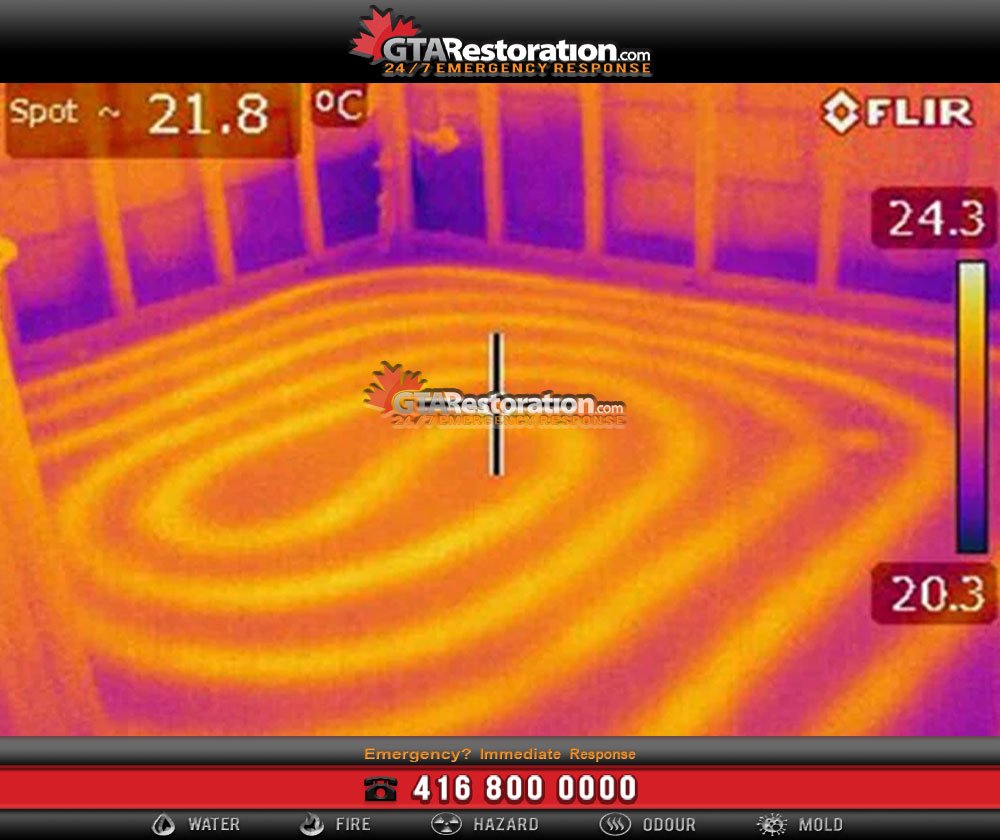
Most importantly, no single tool can confirm every hidden leak. Moisture meters can identify elevated moisture, while thermal imaging may reveal temperature patterns that suggest areas needing further investigation. Technicians may still need physical inspection or selective access to confirm the source.
Signs You May Have a Hidden Water Leak
Hidden leaks do not always produce visible dripping water. For example, you may notice staining, peeling paint, damp drywall, swollen flooring, musty odours, or unexplained increases in water use.
Common warning signs include:
- Water stains on walls or ceilings
- Soft or swollen drywall
- Warped flooring
- Recurring damp areas
- Musty or unusual odours
- Dripping or running-water sounds
- Condensation in an unexpected area
- Water appearing without an obvious source
However, these signs do not always prove that a plumbing leak is present. Condensation, roof leaks, drainage problems, or previous water damage may create similar symptoms.
Common Sources of Hidden Water Leaks
Water can enter a property from several sources. Therefore, leak detection should start by identifying the type of system or building area involved.
Possible sources include:
- Supply pipes
- Plumbing fittings and valves
- Toilet or fixture connections
- Water heaters
- Appliance supply lines
- Drain piping
- Roof leaks
- Foundation or exterior water entry
- Condensation around mechanical systems
Our Montreal Water Leak Detection Process
1. Review the Symptoms
First, the technician reviews where the property owner noticed water, staining, odour, or other signs. Then, the inspection can focus on the most likely areas.
2. Complete a Visual Inspection
Next, the technician checks visible plumbing, fixtures, ceilings, walls, floors, and nearby building components. For example, staining around a ceiling may lead to inspection of plumbing or roofing above that area.
3. Check Moisture Levels
Moisture meters can help identify areas with elevated moisture. However, a moisture reading does not automatically identify the exact leak source.
4. Use Thermal Imaging Where Helpful
Thermal imaging can show surface temperature differences that may indicate an area worth checking more closely. Therefore, technicians may use it as a supporting inspection tool rather than as proof of a leak.
5. Use Other Leak Detection Methods if Needed
Depending on the situation, technicians may use acoustic methods, flow observations, pressure testing, dye testing, or other suitable techniques. However, the correct method depends on the plumbing system and suspected source.
6. Confirm the Likely Source
Finally, the technician compares the inspection findings and test results. If the source remains hidden, selective access may be needed to confirm the exact problem before repairs begin.
Moisture Meter Inspection
Moisture meters help technicians compare moisture levels between materials and areas. For example, a meter may show that drywall or flooring contains more moisture than nearby unaffected material.
However, elevated moisture does not necessarily reveal where the water started. The technician must interpret the readings together with the building layout and other inspection findings.
Thermal Imaging for Leak Investigation
Thermal imaging measures surface temperature patterns. As a result, it may help identify cooler or warmer areas that deserve further inspection.
Thermal imaging does not directly detect water, moisture, mold, or the exact leak source. Instead, technicians use it together with moisture readings and physical inspection.
Acoustic Leak Detection Montreal
Acoustic leak detection can help with certain pressurized plumbing leaks by listening for sound created by escaping water. For example, this method may help narrow down a leak inside a pipe or concealed plumbing area.
However, acoustic methods do not work equally well in every situation. Pipe material, water pressure, background noise, and leak size can all affect the results.
Flow and Pressure Testing
Flow or pressure changes can sometimes help identify whether a plumbing system may be losing water. Therefore, these methods can support the inspection when a concealed pressurized leak is suspected.
However, changes in flow or pressure can also have other causes. The technician should interpret the results together with the rest of the inspection.
Dye Testing for Water Leaks
Dye testing can help trace some types of water movement. For example, technicians may use it when they need to determine whether water is passing through a particular drain, fixture, or suspected pathway.
The method should match the suspected source and building conditions.
Hidden Leaks Behind Walls and Ceilings
Water can travel away from its original source before becoming visible. For this reason, a stain on a wall or ceiling does not always sit directly below the leak.
Technicians may inspect surrounding materials and nearby plumbing before deciding whether any area needs to be opened.
Condo Water Leak Detection Montreal
Leaks in condos can affect more than one unit. Water may move through floors, walls, ceilings, plumbing openings, and neighbouring spaces.
As a result, the investigation may require coordination with the unit owner, property manager, plumber, restoration team, or neighbouring unit.
Commercial Water Leak Detection Montreal
GTA Restoration also provides water leak detection Montreal support for offices, retail spaces, restaurants, warehouses, commercial buildings, and managed properties.
For businesses, leak investigation may need to consider tenant areas, equipment, mechanical rooms, plumbing systems, and ongoing operations.
Water Damage After a Hidden Leak
Finding and repairing the source does not automatically dry affected materials. Water may remain inside drywall, flooring, insulation, cabinets, or other building materials.
Therefore, the property may also need:
- Water extraction
- Moisture checks
- Structural drying
- Removal of damaged materials when needed
- Cleaning
- Repairs after drying
For related restoration work, see our Montreal Water Damage service.
Mold Concerns After a Hidden Leak
Long-term damp conditions can support mold growth. Therefore, correcting the leak and drying affected materials should come first.
However, a moisture reading or musty smell does not confirm mold. If visible growth or ongoing moisture concerns are present, a separate mold assessment may be appropriate.
For related information, see our Montreal Mold Removal service.
Water Leak Insurance Documentation
Insurance coverage depends on the cause of the leak and the policy. Therefore, property owners should contact their insurer or broker if a claim may apply.
Our team can document visible damage, moisture findings, affected materials, inspection areas, and restoration work. However, the insurer decides coverage based on the policy, cause, deductible, limits, and exclusions.
Montreal Water Leak Detection FAQs
Can thermal imaging find the exact leak?
No. Thermal imaging may show temperature patterns that help guide the inspection, but technicians still need other methods to confirm the source.
Do moisture meters identify the leak source?
No. Instead, they show areas with elevated moisture that may need further investigation.
Can acoustic testing find hidden pipe leaks?
Sometimes. Acoustic methods may help with certain pressurized leaks, but pipe type, pressure, noise, and leak size can affect the results.
Will walls always need to be opened?
No. However, selective access may become necessary if the source remains hidden after non-invasive inspection.
Do you provide leak detection for commercial properties?
Yes. GTA Restoration provides leak investigation and related water-damage support for residential and commercial properties in Montreal.
For local information about water services and property water concerns, see the City of Montréal water information.
Need Water Leak Detection in Montreal?
GTA Restoration provides moisture checks, thermal imaging, leak investigation, and related water-damage support for homes and businesses in Montreal.
Leak Detection | Vancouver Water Leak Detection | Toronto Water Leak Detection | Montreal Fire Restoration | Montreal Odor Removal For non-emergencies use our contact form
Water Leak Detection Services in Montreal
GTA Restoration provides Montreal Water Leak Detection services for homes, condos, rental properties, offices, retail spaces, and commercial buildings. In addition, our team can investigate hidden moisture, water stains, suspected plumbing leaks, and related water damage.
Visual Leak Inspection
The investigation starts with visible signs such as staining, damp materials, damaged finishes, or active dripping. Therefore, technicians first review the areas where the property owner noticed a problem.
Moisture Meter Checks
Moisture meters can identify materials with elevated moisture. However, they do not automatically identify the exact source of a leak, so technicians compare the readings with other findings.
Thermal Imaging
Thermal cameras can show surface temperature differences that may indicate areas worth checking. For this reason, technicians use thermal imaging as a supporting tool rather than as direct proof of moisture or a leak.
Acoustic Leak Detection
Acoustic methods may help identify certain pressurized pipe leaks by detecting the sound of escaping water. However, results depend on the pipe system, pressure, background noise, and size of the leak.
Hidden Wall and Ceiling Leaks
Water can travel through walls, ceilings, floors, and cavities before it becomes visible. As a result, technicians may need to inspect a wider area than the visible stain.
Condo and Commercial Properties
Our water leak detection Montreal services support condos, apartment buildings, offices, retail spaces, restaurants, warehouses, and managed properties. Likewise, larger buildings may require coordination with property management or other trades.
Water Damage After Leak Detection
Finding and repairing a leak does not automatically dry the affected area. Therefore, technicians may also need to check drywall, flooring, insulation, or other materials for remaining moisture.
Insurance Documentation
If an insurance claim is involved, our team can record visible damage, moisture findings, affected materials, and restoration work. However, your insurer determines coverage based on the policy, cause, deductible, limits, and exclusions.
Service Areas Across Canada
GTA Restoration serves communities across Canada, including Toronto and the GTA. U.S. locations are opening. Browse our Canadian service areas below, and contact us to confirm services and availability for your address.
Search
- Air Duct Cleaning Montreal
- Ajax Asbestos Removal
- Ajax Mold Removal
- Ajax Water Damage
- Asbestos Removal Calgary
- Asbestos Removal Edmonton
- Asbestos Removal Fort Saskatchewan
- Asbestos Removal Gloucester
- Asbestos Removal Grimsby
- Asbestos Removal Hamilton
- Asbestos Removal Kanata
- Asbestos Removal Kitchener
- Asbestos Removal Laval
- Asbestos Removal Lincoln
- Asbestos Removal Montreal
- Asbestos Removal Nepean
- Asbestos Removal Niagara Falls
- Asbestos Removal Orleans
- Asbestos Removal Ottawa
- Asbestos Removal Sherwood Park
- Asbestos Removal Spruce Grove
- Asbestos Removal St Catharines
- Asbestos Removal St-Albert
- Asbestos Removal Thorold
- Asbestos Testing Hamilton
- Asbestos Testing Montreal
- Asbestos Testing Petersburg
- Aurora Mold Removal
- Aurora Water Damage
- Beaconsfield Asbestos Removal
- Brampton Asbestos Removal
- Brampton Mold Removal
- Brampton Water Damage
- Burlington Asbestos Removal
- Burlington Mold Removal
- Burlington Water Damage
- Burst Pipe Montreal Frozen Pipe
- Burst Pipe Repair Edmonton
- Burst Pipe Repair Ottawa
- Caledon Mold Removal
- Caledon Water Damage
- Calgary Mold Removal
- Calgary Water Damage
- Cambridge Mold Removal
- Cambridge Water Damage
- Clarington Mold Removal
- Concord Mold Removal
- Concord Water Damage
- Cooksville Mold Removal
- Edmonton Water Damage
- Emergency Roofing Vancouver
- Etobicoke Asbestos Removal
- Etobicoke Mold Removal
- Etobicoke Water Damage
- Fire Damage Grimsby
- Fire Damage Lincoln
- Fire Damage Niagara Falls
- Fire Restoration Fort McMurray
- Fire Damage Restoration Thorold
- Fire Damage St Catharines
- Flood Cleanup Grimsby
- Flood Cleanup Lincoln
- Flood Cleanup Niagara Falls
- Flood Cleanup St Catharines
- Flood Cleanup Thorold
- London Mold Removal
- London Water Damage
- Markham Asbestos Removal
- Markham Mold Removal
- Markham Water Damage
- Mississauga Asbestos Testing
- Mississauga Mold Removal
- Mississauga Water Damage
- Mold Inspection Removal Kitchener
- Mold Remediation Montreal
- Mold Removal & Inspection LaSalle
- Mold Removal Anjou
- Mold Removal Boucherville
- Mold Removal Brossard
- Mold Removal Burnaby
- Mold Removal Chambly
- Mold Removal Chateauguay
- Mold Removal Chomedey
- Mold Removal Coquitlam
- Mold Removal Dollard Des Ormeaux
- Mold Removal Dorval
- Mold Removal Edmonton
- Mold Removal Fort Saskatchewan
- Mold Removal Gloucester
- Mold Removal Grimsby
- Mold Removal Hamilton Inspection
- Mold Removal Ile Bizard
- Mold Removal in Osgoode
- Mold Removal Beaconsfield
- Mold Removal Kahnawake
- Mold Removal Kanata
- Mold Removal Kirkland
- Mold Removal Laval
- Mold Removal Lincoln
- Mold Removal Longueuil
- Mold Removal Montreal East
- Mold Removal Mount Royal
- Mold Removal Nepean
- Mold Removal New Westminster
- Mold Removal Niagara Falls
- Mold Removal Orleans
- Mold Removal Ottawa
- Mold Removal Cumberland
- Mold Remediation Hampstead
- Mold Removal Remediation Roxboro
- Mold Removal Richmond BC
- Mold Removal Rideau Lakes
- Mold Removal Rockcliffe Park
- Mold Removal Saint Hubert
- Mold Removal Saint Laurent
- Mold Removal Sherwood Park
- Mold Removal Spruce Grove
- Mold Removal St Catharines
- Mold Removal Ste Dorothee
- Mold Removal St۔ Albert
- Mold Removal Surrey
- Mold Removal Thorold
- Mold Removal Vancouver
- Mold Removal Vanier
- Mold Removal Westmount
- Montreal Biohazard Cleanup
- Montreal Emergency Plumber
- Montreal Fire Restoration
- Montreal Flood Cleanup
- Montreal Odor Removal
- Montreal Roofing Emergency
- Montreal Sewer Backup Cleanup
- Montreal Water Leak Detection
- Montréal Asbestos Removal
- Montréal Emergency Plumbing
- Montréal Mold Removal
- Montréal Pipe Burst Emergency
- Montréal Water Damage
- Newmarket Mold Removal
- Newmarket Water Damage
- North York Mold Removal
- Oakville Mold Removal
- Oakville Water Damage
- Oshawa Mold Removal
- Oshawa Water Damage
- Ottawa Air Duct Cleaning
- Pickering Mold Removal
- Pickering Water Damage
- Red Deer Water Damage
- RedDeer Mold Removal
- Richmond Hill Mold Removal
- Richmond Hill Water Damage
- Roof Repair Lincoln
- Roof Repair Niagara Falls
- Roof Repair St Catharines
- Scarborough Asbestos Removal
- Scarborough Mold Removal
- Scarborough Water Damage
- Sewage Cleanup Edmonton
- Sewer Backup Lincoln
- Sewer Backup Niagara Falls
- Sewer Backup Ottawa
- Sewer Backup St Catharines
- Thornhill Mold Removal
- Toronto & GTA Asbestos Removal
- Toronto & GTA Mold Removal
- Toronto Air Duct Cleaning
- Toronto Water Damage
- Unionville Mold Removal
- Unionville Water Damage
- Vancouver Asbestos Removal
- Vancouver Biohazard Cleanup
- Vancouver Emergency Plumber
- Vancouver Emergency Plumbing
- Vancouver Fire Restoration
- Vancouver Flood Cleanup
- Vancouver Mold Removal
- Vancouver Odor Removal
- Vancouver Pipe Burst Emergency
- Vancouver Sewer Backup Cleanup
- Vancouver Water Damage
- Vancouver Water Leak Detection
- Vaughan Mold Removal
- Vaughan Water Damage
- Vermiculite Removal Ottawa
- Water Damage Grimsby
- Water Damage Kanata
- Water Damage Kitchener
- Water Damage Lincoln
- Water Damage Longueuil
- Water Damage Nepean
- Water Damage Niagara Falls
- Water Damage Orleans
- Water Damage Ottawa
- Water Damage Repair Montreal
- Water Damage Laval Montreal
- Water Damage Restoration Thorold
- Sewage Backup Cleanup Montreal
- Water Damage St Catharines
- Water Damage Vancouver
- Water Flood Damage Repair Hamilton
- Flood Damage Repair Hampstead
- Whitby Water Damage
- Woodbridge Asbestos Removal
- Woodbridge Mold Removal
- Woodbridge Water Damage
- Restoration Equipment Rental
Water Leak Detection FAQs
Can thermal imaging find a leak?
It can show temperature patterns that help guide inspection, but technicians still need to confirm the source.
Do moisture meters find the exact source?
No. Instead, they help identify areas with elevated moisture.
Can acoustic testing help?
Yes, in some cases. It may help investigate certain pressurized plumbing leaks.
Will you need to open the wall?
Not always. However, selective access may be needed if the source remains hidden.
Do you inspect commercial properties?
Yes. GTA Restoration provides leak investigation for residential and commercial properties in Montreal.
Direct Billing & Insurance Claims
Ask your insurer about coverage, deductibles and the records it needs.

In-House Financing Available
Financing up to 24 months. No interest. No money down. Ask us about the terms.
Learn more ↴ 
RELATED ARTICLES
 Facebook
  Instagram
  LinkedIn
  X / Twitter
  YouTube