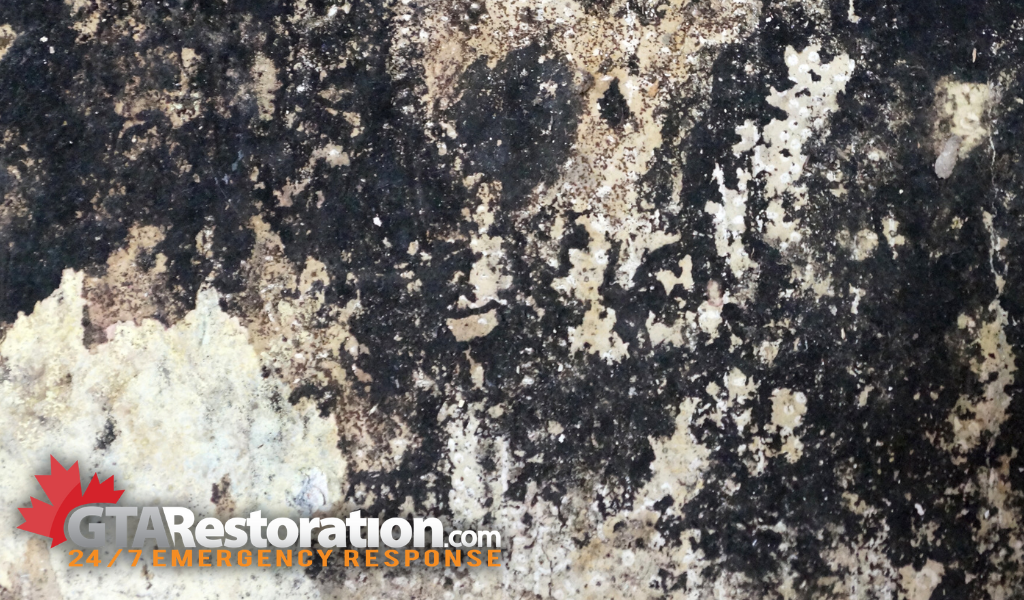
Black Mold Growing On The Walls That Needs Remediation
If you are wondering what is black mold, the simple answer is that black mold is a general term often used for dark-coloured mold growing in damp areas of a home or building.
One species commonly associated with this name is Stachybotrys chartarum. However, colour alone cannot reliably identify a mold species. Many types of mold can appear black, dark green, brown, or grey.
What matters most is not the colour. Instead, the main concern is why the mold is growing and where the moisture is coming from.
Mold can develop when building materials remain damp for prolonged periods. Therefore, bathrooms, basements, kitchens, laundry rooms, attics, and areas affected by water damage are common places to find mold growth.
GTA Restoration provides professional mold inspection, removal, and remediation services throughout Toronto and the GTA.
Black mold is a general term for mold that appears dark in colour and grows where moisture is present. Stachybotrys chartarum is one species commonly associated with the term, although other molds can look similar.
For example, common warning signs may include:
Dark green, black, or brown patches
Musty or earthy odours
Water stains
Damp drywall
Condensation
Peeling paint
Recurring moisture
Growth around windows or plumbing
Therefore, the safest approach is to focus on the moisture source and extent of growth rather than trying to identify mold by colour alone.
Mold is a type of fungus that reproduces through microscopic spores.
These spores naturally exist indoors and outdoors. In most cases, they do not become a significant problem unless they settle on damp materials and conditions support growth.
For example, mold may develop on:
Drywall
Wood
Paper
Ceiling tiles
Carpet backing
Insulation
Fabric
Dust-covered surfaces
Stachybotrys chartarum can grow on cellulose-rich materials that remain wet.
However, other mold species can look very similar. Therefore, visual appearance alone cannot confirm exactly which species is present.
Mold spores can enter a home in many ordinary ways.
For instance, spores may travel through:
Open windows
Exterior doors
Ventilation systems
Clothing
Shoes
Pets
Outdoor air
Because mold spores are common in the environment, eliminating them completely is nearly impossible.
The more important factor, however, is moisture.
Once spores settle on a damp surface, mold may develop if suitable conditions continue.
As a result, moisture control is one of the most effective ways to reduce indoor mold growth.
Mold growth is usually connected to excess moisture or humidity.
For example, common causes include:
Plumbing leaks
Roof leaks
Basement seepage
Flooding
Condensation
High indoor humidity
Poor bathroom ventilation
Wet insulation
Appliance leaks
Window condensation
Sewer or drain problems
A small plumbing leak behind a wall may remain unnoticed for an extended period.
Meanwhile, drywall and insulation can stay damp, creating conditions that support mold growth.
Therefore, identifying and correcting the moisture source is an essential part of proper mold remediation.
People can react differently to mold.
For instance, some individuals may experience no noticeable symptoms. Others may develop irritation or allergy-like reactions.
Possible symptoms can include:
Sneezing
Coughing
Nasal congestion
Itchy or watery eyes
Throat irritation
Skin irritation
Wheezing
People with asthma, mold allergies, or certain respiratory conditions may be more sensitive to damp or moldy environments.
In addition, individuals with weakened immune systems may need additional medical guidance when significant mold exposure is a concern.
However, symptoms alone cannot confirm that mold is the cause.
If you experience persistent or severe symptoms, speak with a qualified healthcare professional.
Allergic reactions are among the health concerns associated with mold exposure.
For example, a sensitive person may experience sneezing, a runny nose, coughing, itchy eyes, or skin irritation.
These symptoms may become more noticeable while spending time in a damp or mold-affected environment.
However, similar symptoms can have many other causes.
Therefore, medical symptoms should be evaluated separately from the condition of the building.
Mold can also irritate the respiratory system in some people.
For example, those with asthma may notice increased coughing, wheezing, or breathing difficulty in certain damp or mold-affected environments.
For this reason, controlling indoor moisture and addressing significant visible mold can be important for maintaining a healthy indoor environment.
If someone experiences serious breathing difficulty or another urgent medical concern, seek immediate medical attention.
The term black mold often sounds more alarming than it needs to.
Not every dark-coloured mold is Stachybotrys chartarum, and not every mold exposure causes serious illness.
However, significant indoor mold growth should be addressed regardless of colour.
In particular, the main concerns include:
Ongoing moisture
Damage to building materials
Allergic or respiratory irritation
Indoor environmental conditions
Continued mold spread
Therefore, the goal should be to address the mold properly while correcting the moisture problem that allowed it to grow.

Get GTA Restoration To Clean Your Black Mold Problems
Visible mold often appears as spots, patches, or irregular staining.
For example, common colours include:
Black
Dark green
Brown
Grey
In addition, you may notice a musty or earthy odour.
Check moisture-prone areas such as:
Bathrooms
Basements
Kitchens
Laundry rooms
Window areas
Attics
Under sinks
Around plumbing
Behind furniture
Along foundation walls
If mold keeps returning after cleaning, an unresolved moisture problem may still be present.
As a result, finding and correcting the source is more important than repeatedly wiping the visible surface.
Mold is not always visible.
Therefore, watch for warning signs such as:
Persistent musty odours
Bubbling paint
Peeling wallpaper
Repeated water staining
Damp drywall
Warped baseboards
Condensation
Previous flooding
Unexplained moisture
For example, a wall surface may appear normal while insulation or other materials behind it remain damp.
In these situations, a moisture inspection may be useful before opening walls or disturbing building materials.
Preventing mold mainly comes down to controlling moisture.
Therefore, focus on humidity, leaks, ventilation, and proper drying.
High indoor humidity can support mold growth.
Generally, indoor relative humidity should remain below 60%. Depending on the season and building conditions, approximately 30% to 50% is often a practical indoor range.
For example, helpful moisture-control methods include:
Exhaust fans
Dehumidifiers
Air conditioning
Proper ventilation
In addition, monitor damp basements, bathrooms, and other moisture-prone areas.
Leaks should be repaired as soon as they are discovered.
For example, water damage can create conditions that support mold when building materials remain wet.
Common leak sources include:
Supply lines
Toilets
Sinks
Roofs
Water heaters
Appliances
Foundation cracks
After repairing the source, affected materials still need to dry properly.
Otherwise, remaining moisture may continue to support mold growth.
Bathrooms and kitchens can produce considerable moisture.
Therefore, use exhaust fans while showering, cooking, or producing steam.
Whenever possible, make sure exhaust fans vent outdoors rather than into an attic or other enclosed space.
In addition, allow air to circulate around furniture positioned against cold exterior walls.
Sometimes.
For example, a very small area of surface mold may be manageable for a homeowner when:
The moisture source has been corrected
Growth is limited
The affected material can be cleaned
Sewage or contaminated water was not involved
There are no significant health concerns
However, DIY cleanup is not appropriate for every situation.
In particular, large affected areas, recurring growth, hidden mold, or contamination inside wall and ceiling cavities usually require further investigation.
For a small and limited area:
First, correct the moisture source.
Next, use appropriate personal protective equipment.
During cleanup, avoid spreading dust or debris into other rooms.
When appropriate, clean suitable hard surfaces using the correct method.
Afterward, dry the affected area completely.
Finally, discard porous materials that cannot be adequately cleaned.
Avoid simply painting over mold.
Paint does not correct the moisture problem or remove affected material underneath.
In addition, never mix cleaning chemicals together.
Professional mold remediation may be the better option when:
Growth covers a large area
Mold repeatedly returns
Drywall or insulation is affected
The moisture source is hidden
Sewage or contaminated water was involved
Several rooms are affected
Mold is inside walls or ceilings
The property has ongoing moisture problems
A commercial or multi-unit building is affected
In these situations, a professional mold remediation service can assess the extent of the problem and determine what requires cleaning, removal, containment, or drying.
Depending on the property and extent of contamination, professional remediation may involve:
Moisture inspection
Containment
HEPA air filtration
Removal of affected porous materials
HEPA vacuuming
Detailed cleaning
Disposal of contaminated debris
Structural drying
Final cleaning
However, the exact process depends on the location, materials, moisture conditions, and extent of mold growth.
Most importantly, the underlying moisture problem must be corrected.
Otherwise, mold may return after remediation.
Testing is not always necessary when visible mold growth is already present.
For example, if the problem is obvious, the priority is often to determine the moisture source and address the affected materials properly.
However, mold testing may be useful in certain situations, including when:
Mold is suspected but not visible
Indoor environmental conditions require further investigation
An assessment requires additional information
A third party requests documentation
Post-remediation verification is required
Therefore, a qualified mold inspector can help determine whether testing provides useful information for the situation.
Basements can be particularly vulnerable because they are often cooler and may experience higher humidity, foundation moisture, or groundwater intrusion.
For example, common basement mold causes include:
Foundation seepage
Flooding
Sump pump failure
High humidity
Poor ventilation
Wet carpet
Damp drywall
Plumbing leaks
Therefore, basement mold remediation should address both the affected materials and the moisture source.
A dehumidifier may help control humidity. However, it will not repair an active leak or remove damaged building materials.
Bathrooms commonly develop surface mold because of steam, humidity, and condensation.
For example, problem areas can include:
Shower ceilings
Grout
Window frames
Caulking
Vanity cabinets
Walls beside tubs
Therefore, improve ventilation, operate the exhaust fan, and repair plumbing leaks promptly.
If mold repeatedly returns or appears to extend behind drywall or cabinetry, further inspection may be necessary.

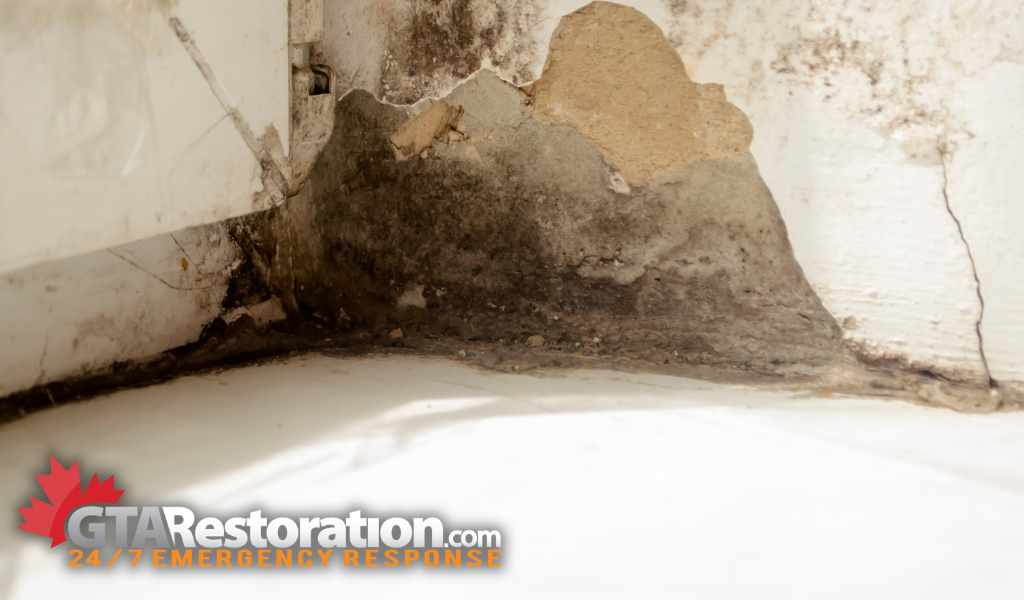
Example Of Black Mold In The Corner Of A Room With Water Damage
Water damage can create conditions that support mold growth when affected materials remain damp.
For example, drywall, insulation, carpet, and wood may retain moisture even after visible standing water has been removed.
Therefore, proper drying after a leak or flood can help reduce the risk of future mold problems.
This is especially important following:
Flooded basements
Burst pipes
Roof leaks
Appliance failures
Sewer backups
Most importantly, addressing the water source and confirming that affected areas are properly dried can help prevent recurring mold.
To reduce the risk of mold growth:
First, repair plumbing and roof leaks quickly.
Next, control indoor humidity.
In addition, operate bathroom and kitchen exhaust fans.
After water damage, dry affected materials promptly.
Regularly monitor basements for seepage.
Likewise, check sump pumps for proper operation.
During humid weather, watch windows for excessive condensation.
If you notice musty odours or water stains, investigate the source.
Finally, correct recurring moisture instead of covering the problem.
In short, keeping building materials dry is one of the most effective ways to reduce significant indoor mold growth.
Mold exposure can cause irritation or allergy-like symptoms in some people.
For example, symptoms may include coughing, sneezing, itchy eyes, nasal irritation, or wheezing.
However, people react differently, and symptoms alone cannot prove that mold is the cause.
Therefore, if symptoms are severe or persistent, consult a qualified healthcare professional.
Look for dark-coloured patches, musty odours, moisture, water staining, or recurring dampness.
However, colour alone cannot confirm the exact mold species.
Therefore, a professional inspection may be useful when growth is hidden, widespread, or connected to an unknown moisture source.
Some people may experience irritation, allergy-like reactions, or respiratory symptoms in damp or moldy environments.
For example, people with asthma, mold allergies, or certain medical conditions may be more sensitive.
Therefore, significant indoor mold growth should be addressed rather than ignored.
First, control moisture.
Then, repair leaks, manage indoor humidity, improve ventilation, and dry water-damaged materials properly.
As a result, these steps are more effective than repeatedly cleaning visible mold without correcting the underlying cause.
Small areas of surface mold may sometimes be manageable.
However, larger areas, hidden mold, contaminated water losses, recurring growth, or mold inside wall and ceiling cavities are better assessed professionally.
Therefore, if you are unsure about the extent or source, arrange an inspection before disturbing the affected materials.
If you have visible mold, a strong musty odour, recurring moisture, or mold following water damage, do not simply cover the area with paint or wait for the problem to disappear.
Instead, GTA Restoration provides professional mold inspection, removal, and remediation throughout Toronto and the GTA.
Our team can assess moisture conditions, inspect affected materials, establish containment when necessary, remove damaged materials, clean the affected area, and help identify the source of the moisture.
Whether the problem involves a basement, bathroom, water-damaged wall, commercial property, or another affected area, the goal is to address both the mold and the conditions that allowed it to develop.
Tell us where the mold is located, whether there has been recent water damage, and approximately how large the affected area appears to be. From there, our team can explain the appropriate next steps.
For non-emergencies use our contact form
Stachybotrys chartarum can develop when spores settle on damp, cellulose-rich materials such as drywall, wood, or paper. Persistent moisture from leaks, flooding, or high humidity creates conditions that support mold growth.
As colonies develop, mold can spread across affected materials and release additional spores. Therefore, controlling moisture and addressing mold early can help prevent a small problem from becoming a larger infestation.
Mildew usually refers to light-coloured, powdery fungal growth found on damp surfaces. Stachybotrys chartarum, meanwhile, is commonly associated with dark growth on water-damaged, cellulose-rich materials.
However, colour and appearance alone cannot reliably identify a mold species. If dark mold is widespread, hidden, or repeatedly returning, a professional assessment may be appropriate.
Mold coverage depends on your insurance policy and the cause of the moisture. For example, mold resulting from a sudden covered water loss may receive some coverage, while damage caused by long-term leaks, poor maintenance, or ongoing moisture may be excluded.
Therefore, review your policy and contact your insurer before assuming mold remediation is covered. Coverage, limits, deductibles, and exclusions vary by policy.
Children, older adults, people with asthma, and individuals with certain health conditions may be more sensitive to damp or moldy environments.
Possible reactions can include coughing, wheezing, nasal irritation, itchy eyes, or other allergy-like symptoms. However, mold affects people differently, and symptoms alone cannot confirm mold exposure as the cause. Anyone experiencing persistent or serious symptoms should seek medical advice.
Nationwide, Local Pricing
GTA Restoration offers local flood & water damage repair, mold removal/remediation, asbestos removal/abatement, fire/smoke damage repair services and much more.
Search
What is Black Mold Symptoms, Prevention, and Solution Tips
We Work Direct with All Insurance Companies
Wᴇ ᴀʀᴇ ᴄᴏᴍᴍɪᴛᴛᴇᴅ ᴏɴ ᴡᴏʀᴋɪɴɢ ᴡɪᴛʜ ᴇᴠᴇʀʏ ɪɴsᴜʀᴀɴᴄᴇ ᴄᴏᴍᴘᴀɴʏ ᴀᴄʀᴏss Cᴀɴᴀᴅᴀ & USA.
Learn more ↴
RELATED ARTICLES
Emergency? Immediate response 24/7
We cover all GTA 24/7.
Head Office:
250 Consumers Rd,
#10
Toronto, ON
M2J 4V6,
Open 24 hours
Downtown Office:
250 Yonge St,
#10
Toronto, ON
M5B 2L7,
Open 24 hours
For non-emergencies use our contact form
Not sure what you need?
Call us today to find the best product for your situation.
Head Office:
101 Lebovic Ave,
Unit #10
Scarborough,
ON, M1L 4T7 Hours24-Hours Open
Downtown Office:
250 Yonge Street,
Unit #1A
Toronto,
ON, M5B 2L7 Hours24-Hours Open
What Is Black Mold? Symptoms, Prevention, and Solutions
Get a quote today