Air Scrubber vs Dehumidifier After Smoke Damage
Last Updated: October 23, 2026 If you’ve ever wondered about the differences between an air scrubber vs dehumidifier, this guide will help you understand which one is right for your needs.
Quick Summary
In an air scrubber vs dehumidifier comparison after smoke damage, the air scrubber filters soot, ash and smoke particles while the dehumidifier removes water vapor. A fire usually leaves both behind, so running both machines is common after most fires.
- Place the air scrubber near the soot source and change the pre-filter often.
- Firefighting water soaks into drywall, insulation and framing, and trapped humidity can lead to mold within days.
- Light soot cases may need several days of scrubbing; heavier contamination can take a week or more.
- A dehumidifier removes water vapor, not soot or odor, so filtration is still required.
- Ducts, cavities and attics can hold smoke residue long after visible rooms look clean.
Table of Contents
- Air Scrubber vs Dehumidifier After Smoke Damage: What Each Does
- Air Scrubber for Smoke Damage: Particle Capture and Soot
- Dehumidifier After a Fire: Moisture Control and Humidity
- How Long to Run an Air Scrubber and When to Bring In Help
- Restoration Support
- Frequently Asked Questions
Air Scrubber vs Dehumidifier After Smoke Damage: What Each Does
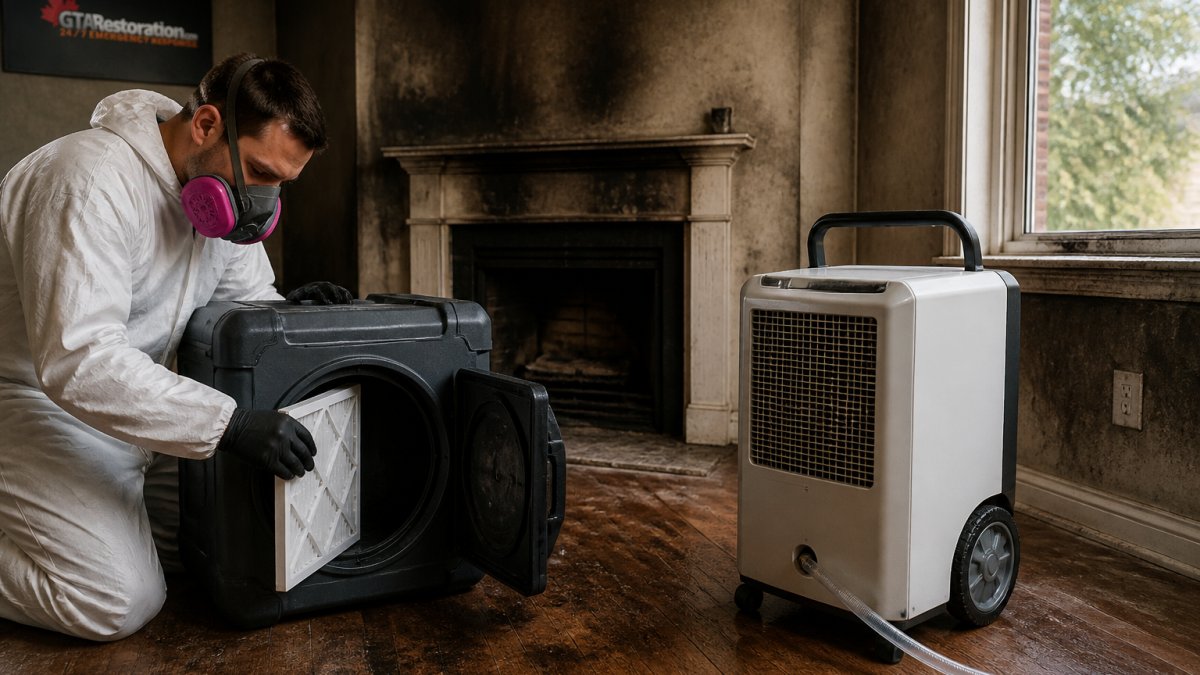
An air scrubber vs dehumidifier comparison after smoke damage comes down to particles versus moisture. An air scrubber filters soot, ash and smoke particles; a dehumidifier removes water vapor. A fire usually leaves both behind.
| Machine | What it removes | Best used for | Where it falls short |
|---|---|---|---|
| Air scrubber | Airborne soot, ash, fine particles | Post-fire cleanup, odor reduction | Does not remove moisture or gases |
| Dehumidifier | Water vapor from the air | Drying after firefighting water | Does not capture particles or soot |
Air Scrubber for Smoke Damage: Particle Capture and Soot
An air scrubber for smoke damage moves air through a HEPA filter and a pre-filter that catches larger debris. Place it near the soot source and change the pre-filter often. A scrubber traps particles, not gases, so lingering odor still needs ventilation and cleaning.
Dehumidifier After a Fire: Moisture Control and Humidity
A dehumidifier after a fire addresses a problem most homeowners underestimate. Firefighting water soaks into drywall, insulation and framing, and trapped humidity can lead to mold growth within days. Keep the drying zone closed and drain the reservoir consistently.
How Long to Run an Air Scrubber and When to Bring In Help
How long to run an air scrubber depends on space size, soot levels and how well the area is sealed. Light cases may run several days; heavier contamination can take a week or more. For a significant fire, a professional inspection is the safer path.
Restoration Support
Sorting particles from moisture is the first step in any smoke cleanup. Here is how we handle the details.
Match the Machine to the Problem
Use a scrubber for soot and a dehumidifier for dampness. Running both is common after most fires.
Place Equipment Where It Counts
Put the scrubber near the soot source and keep air moving between rooms.
Change Filters Often
Pre-filters load quickly after a fire. Fresh filters keep filtration efficiency steady.
Watch the Humidity
A dehumidifier only helps when the drying zone stays closed and the unit keeps running.
Do Not Skip Surface Cleaning
Filtration clears the air, but soot on surfaces still needs wiping and washing.
Check Hidden Spaces
Ducts, cavities and attics can hold smoke residue long after visible rooms look clean.
Watch for Mold Risk
Trapped humidity after firefighting water can trigger mold growth within days.
Know When to Call a Professional
Heavy contamination or uncertain drying calls for proper moisture readings and inspection.
Unsure whether your space needs filtration, drying, or both? Our team can assess the damage and explain the next steps.
Frequently Asked Questions
What is the difference between an air scrubber and a dehumidifier after smoke damage?
An air scrubber pulls airborne particles, including soot and smoke particles, through a HEPA filter. A dehumidifier removes moisture from the air. After smoke damage, the scrubber cleans the air while the dehumidifier controls humidity that can slow drying and encourage mold. They solve different problems, so neither replaces the other.
Can a dehumidifier remove smoke odour from a home?
No. A dehumidifier lowers indoor humidity but does not trap smoke particles or absorb organic gases that cause odour. Smoke odour removal usually needs particle filtration plus ventilation and cleaning of soot-covered surfaces. In some cases, professional treatment of porous materials is required before the smell clears.
Should you use an air scrubber and dehumidifier together after a fire?
Often, yes. Run the air scrubber in the affected area to capture airborne particles, and use the dehumidifier if moisture from firefighting or humidity is present. Keep windows closed during scrubbing so the unit can filter the room air.

For non-emergencies use our contact form
Air Scrubber vs Dehumidifier After Smoke Damage
An air scrubber vs dehumidifier comparison helps you choose the right tools after a fire. An air scrubber filters smoke particles from the air. In contrast, a dehumidifier removes moisture from the air.
However, neither machine removes soot from walls or fixes damaged materials. First, make sure the site is safe to enter. Then, check the smoke and water damage.
Air Scrubber vs Dehumidifier: Quick Comparison
| Equipment | Main Job | What It Cannot Do |
|---|---|---|
| HEPA Air Scrubber | Filters airborne soot, smoke particles, and dust. | Does not dry wet materials or remove every gas. |
| Dehumidifier | Removes water vapour to help control damp air. | Does not filter soot or clean smoke residue. |
Both machines have different jobs. Therefore, the right choice depends on the damage found during the site check.
Air Scrubber for Smoke Damage
A HEPA air scrubber filters fine smoke particles from air passing through the unit. It can also help control dust during cleanup.
However, filters need care. Also, the machine must suit the room size and work area.
See our HEPA air scrubber rental for more details.
Dehumidifier After Fire Damage
Fire crews may use water to put out a fire. As a result, walls, floors, and wood may stay wet.
A dehumidifier removes moisture from the air as materials dry. However, it cannot remove standing water or smoke particles.
Compare our large dehumidifier rental for drying jobs.
When Should You Use Both Machines?
Some fires leave both smoke and water damage. In that case, air filtration and drying may be needed together.
First, assess the soot and wet materials. Then, choose a safe setup for each task. However, a dry smoke loss may not need a dehumidifier.
Choosing Smoke Cleanup Equipment After a Fire
HEPA Filtration for Smoke and Soot
Smoke can leave fine particles in the air. Therefore, HEPA filtration may help during cleanup.
However, soot on walls and furniture still needs direct cleaning. An air scrubber cannot clean those surfaces.
Moisture Control After Firefighting Water
Water can hide under floors and behind walls. For this reason, crews use moisture meters to check wet areas.
Then, they can plan drying with suitable tools. Also, moisture checks help show how the work is going.
Air Scrubbers and Smoke Odours
HEPA filters trap particles, not most gases. However, some air cleaners use special carbon filters to help reduce certain gases.
Even so, no filter removes every smell. First, clean or remove the source of the odour.
For more details, read the EPA guide to air cleaners.
Check Smoke-Damaged HVAC Systems
Smoke may enter vents and ducts. Therefore, keep affected HVAC equipment off until a trained team checks it.
Also, ask about soot inside filters and ducts. Running the system too soon may spread loose residue.
How Long Should an Air Scrubber Run?
There is no fixed run time for every fire. Instead, the team must check the room size, soot load, and work plan.
Also, filters may need to be changed during the job. Follow the unit guide and site plan.
Safe Air Scrubber and Dehumidifier Setup
First, check the power supply and room access. Then, place the tools as the work plan directs.
Keep air paths clear. Also, avoid blowing loose soot into clean rooms. Wet electrical areas need special care.
Professional Fire and Smoke Cleanup in Toronto
GTA Restoration helps with fire and smoke cleanup in Toronto and the GTA. Our team can assess soot, smoke odours, and water damage. Then, we can plan the cleaning and drying work.
For industry guidance, see the IICRC S700 fire and smoke restoration standard.
Also, read our smoke damage after a home fire guide and browse our restoration equipment rentals.
Need an Air Scrubber or Dehumidifier?
Contact GTA Restoration for fire and smoke cleanup support.
Tell us about the soot, wet areas, and building size.
Choose the right tools before work starts.
Learn More
HEPA Air Scrubber | Large Dehumidifier | Equipment Rental | Smoke Cleaning Products
Service Areas Across Canada
GTA Restoration serves communities across Canada, including Toronto and the GTA. U.S. locations are opening. Browse our Canadian service areas below, and contact us to confirm services and availability for your address.
Search
- Air Duct Cleaning Montreal
- Ajax Asbestos Removal
- Ajax Mold Removal
- Ajax Water Damage
- Asbestos Removal Calgary
- Asbestos Removal Edmonton
- Asbestos Removal Fort Saskatchewan
- Asbestos Removal Gloucester
- Asbestos Removal Grimsby
- Asbestos Removal Hamilton
- Asbestos Removal Kanata
- Asbestos Removal Kitchener
- Asbestos Removal Laval
- Asbestos Removal Lincoln
- Asbestos Removal Montreal
- Asbestos Removal Nepean
- Asbestos Removal Niagara Falls
- Asbestos Removal Orleans
- Asbestos Removal Ottawa
- Asbestos Removal Sherwood Park
- Asbestos Removal Spruce Grove
- Asbestos Removal St Catharines
- Asbestos Removal St-Albert
- Asbestos Removal Thorold
- Asbestos Testing Hamilton
- Asbestos Testing Montreal
- Asbestos Testing Petersburg
- Aurora Mold Removal
- Aurora Water Damage
- Beaconsfield Asbestos Removal
- Brampton Asbestos Removal
- Brampton Mold Removal
- Brampton Water Damage
- Burlington Asbestos Removal
- Burlington Mold Removal
- Burlington Water Damage
- Burst Pipe Montreal Frozen Pipe
- Burst Pipe Repair Edmonton
- Burst Pipe Repair Ottawa
- Caledon Mold Removal
- Caledon Water Damage
- Calgary Mold Removal
- Calgary Water Damage
- Cambridge Mold Removal
- Cambridge Water Damage
- Clarington Mold Removal
- Concord Mold Removal
- Concord Water Damage
- Cooksville Mold Removal
- Edmonton Water Damage
- Emergency Roofing Vancouver
- Etobicoke Asbestos Removal
- Etobicoke Mold Removal
- Etobicoke Water Damage
- Fire Damage Grimsby
- Fire Damage Lincoln
- Fire Damage Niagara Falls
- Fire Restoration Fort McMurray
- Fire Damage Restoration Thorold
- Fire Damage St Catharines
- Flood Cleanup Grimsby
- Flood Cleanup Lincoln
- Flood Cleanup Niagara Falls
- Flood Cleanup St Catharines
- Flood Cleanup Thorold
- London Mold Removal
- London Water Damage
- Markham Asbestos Removal
- Markham Mold Removal
- Markham Water Damage
- Mississauga Asbestos Testing
- Mississauga Mold Removal
- Mississauga Water Damage
- Mold Inspection Removal Kitchener
- Mold Remediation Montreal
- Mold Removal & Inspection LaSalle
- Mold Removal Anjou
- Mold Removal Boucherville
- Mold Removal Brossard
- Mold Removal Burnaby
- Mold Removal Chambly
- Mold Removal Chateauguay
- Mold Removal Chomedey
- Mold Removal Coquitlam
- Mold Removal Dollard Des Ormeaux
- Mold Removal Dorval
- Mold Removal Edmonton
- Mold Removal Fort Saskatchewan
- Mold Removal Gloucester
- Mold Removal Grimsby
- Mold Removal Hamilton Inspection
- Mold Removal Ile Bizard
- Mold Removal in Osgoode
- Mold Removal Beaconsfield
- Mold Removal Kahnawake
- Mold Removal Kanata
- Mold Removal Kirkland
- Mold Removal Laval
- Mold Removal Lincoln
- Mold Removal Longueuil
- Mold Removal Montreal East
- Mold Removal Mount Royal
- Mold Removal Nepean
- Mold Removal New Westminster
- Mold Removal Niagara Falls
- Mold Removal Orleans
- Mold Removal Ottawa
- Mold Removal Cumberland
- Mold Remediation Hampstead
- Mold Removal Remediation Roxboro
- Mold Removal Richmond BC
- Mold Removal Rideau Lakes
- Mold Removal Rockcliffe Park
- Mold Removal Saint Hubert
- Mold Removal Saint Laurent
- Mold Removal Sherwood Park
- Mold Removal Spruce Grove
- Mold Removal St Catharines
- Mold Removal Ste Dorothee
- Mold Removal St۔ Albert
- Mold Removal Surrey
- Mold Removal Thorold
- Mold Removal Vancouver
- Mold Removal Vanier
- Mold Removal Westmount
- Montreal Biohazard Cleanup
- Montreal Emergency Plumber
- Montreal Fire Restoration
- Montreal Flood Cleanup
- Montreal Odor Removal
- Montreal Roofing Emergency
- Montreal Sewer Backup Cleanup
- Montreal Water Leak Detection
- Montréal Asbestos Removal
- Montréal Emergency Plumbing
- Montréal Mold Removal
- Montréal Pipe Burst Emergency
- Montréal Water Damage
- Newmarket Mold Removal
- Newmarket Water Damage
- North York Mold Removal
- Oakville Mold Removal
- Oakville Water Damage
- Oshawa Mold Removal
- Oshawa Water Damage
- Ottawa Air Duct Cleaning
- Pickering Mold Removal
- Pickering Water Damage
- Red Deer Water Damage
- RedDeer Mold Removal
- Richmond Hill Mold Removal
- Richmond Hill Water Damage
- Roof Repair Lincoln
- Roof Repair Niagara Falls
- Roof Repair St Catharines
- Scarborough Asbestos Removal
- Scarborough Mold Removal
- Scarborough Water Damage
- Sewage Cleanup Edmonton
- Sewer Backup Lincoln
- Sewer Backup Niagara Falls
- Sewer Backup Ottawa
- Sewer Backup St Catharines
- Thornhill Mold Removal
- Toronto & GTA Asbestos Removal
- Toronto & GTA Mold Removal
- Toronto Air Duct Cleaning
- Toronto Water Damage
- Unionville Mold Removal
- Unionville Water Damage
- Vancouver Asbestos Removal
- Vancouver Biohazard Cleanup
- Vancouver Emergency Plumber
- Vancouver Emergency Plumbing
- Vancouver Fire Restoration
- Vancouver Flood Cleanup
- Vancouver Mold Removal
- Vancouver Odor Removal
- Vancouver Pipe Burst Emergency
- Vancouver Sewer Backup Cleanup
- Vancouver Water Damage
- Vancouver Water Leak Detection
- Vaughan Mold Removal
- Vaughan Water Damage
- Vermiculite Removal Ottawa
- Water Damage Grimsby
- Water Damage Kanata
- Water Damage Kitchener
- Water Damage Lincoln
- Water Damage Longueuil
- Water Damage Nepean
- Water Damage Niagara Falls
- Water Damage Orleans
- Water Damage Ottawa
- Water Damage Repair Montreal
- Water Damage Laval Montreal
- Water Damage Restoration Thorold
- Sewage Backup Cleanup Montreal
- Water Damage St Catharines
- Water Damage Vancouver
- Water Flood Damage Repair Hamilton
- Flood Damage Repair Hampstead
- Whitby Water Damage
- Woodbridge Asbestos Removal
- Woodbridge Mold Removal
- Woodbridge Water Damage
- Restoration Equipment Rental
Air Scrubber vs Dehumidifier: 11 Key Checks
Choosing an air scrubber vs dehumidifier? First, check the damage. Then, choose the right tools.
1. Check Fire Site Safety
First, make sure the site is safe. Also, keep people away from damaged areas.
2. Check Smoke and Soot
Look for soot and smoke residue. Then, plan how to clean it.
3. Choose an Air Scrubber for Smoke
A HEPA air scrubber filters particles. However, it cannot clean walls or floors.
4. Check Dehumidifier Needs
Fire crews may leave areas wet. Therefore, check for trapped water before choosing drying tools.
5. Review HEPA Air Filters
Check the filter type and size. Also, change dirty filters as the guide directs.
Smoke Cleanup Equipment and Drying
6. Plan Dehumidifier Drying
First, remove standing water. Then, dry wet areas with the right tools.
7. Check Air Scrubber Placement
Place the unit as the work plan directs. Also, keep air paths clear.
8. Watch for Hidden Moisture
Water may hide below floors. Therefore, check wet spots as drying goes on.
9. Plan Smoke Odour Removal
First, remove the source of the smell. However, air filters alone may not clear all odours.
10. Check the Equipment Run Time
Each job is different. So, review the run time with the crew.
11. Choose Smoke Cleanup Equipment
Compare air scrubbers and dehumidifiers. Finally, choose tools that fit the damage.
Need help after fire or smoke damage?
Call GTA Restoration. Also, tell us which rooms have soot or water.
Learn more ↴ 
Latest Blog
Latest Articles
Direct Billing & Insurance Claims
Ask your insurer about coverage, deductibles and the records it needs.

In-House Financing Available
Financing up to 24 months. No interest. No money down. Ask us about the terms.
Certifications & Insurance
View our firm certification, technician qualifications and insurance documents.

IICRC Certified Firm
GTA Restoration Inc.
Firm number 199912
Valid through

Business Insurance
GTA Restoration Group Inc.
$5 million general liability per occurrence
$8 million contractors pollution per claim
–
IICRC Technician Qualifications
Richard Mark Provence · Registration 55726
Certificate expires
Water Damage Restoration · Fire & Smoke Restoration · Applied Microbial Remediation · Odor Control · Trauma & Crime Scene
View technician verification (PDF) — opens in a new tabInsurance is subject to policy terms, conditions and exclusions.
 Facebook
 Instagram
 LinkedIn
 X / Twitter
 YouTube