


...
Mold Removal and Mould Remediation Toronto - GTA Restoration

Emergency? 24-Hrs

416.800.0000
  • Home Restore
  • Emergency Services
    • Emergency Plumbers 24/7
    • Water Damage Restoration
    • Flooded Basement
    • Mold Remediation Toronto
    • Sewer Backup Remediation
    • Fire & Smoke Restoration
    • Odour Removal Toronto
    • Biohazard Cleanup
    • Emergency Roofing Repair
    • Water Leak and Detection
    • Condominium Restoration
    • Basement WaterProofing
    • Property Inspection Toronto
    • Sanitizing and Disinfection
    • Insurance Claim Appraisers
    • Equipment for Rent Toronto
    • Privacy Policy & Service Terms
  • Commercial Restoration
  • Blog
  • Our Team
  • Contact
30 January 2022 - Categories: GTA Restoration Articles

How Does Climate Change Impact Property Owners?


Disaster Restoration Emergency Plumbing Service Blog Icon

How Does Climate Change Impact Property Owners?

How Does Climate Change Impact Property Owners?

Climate Change Impacts on Property Owners

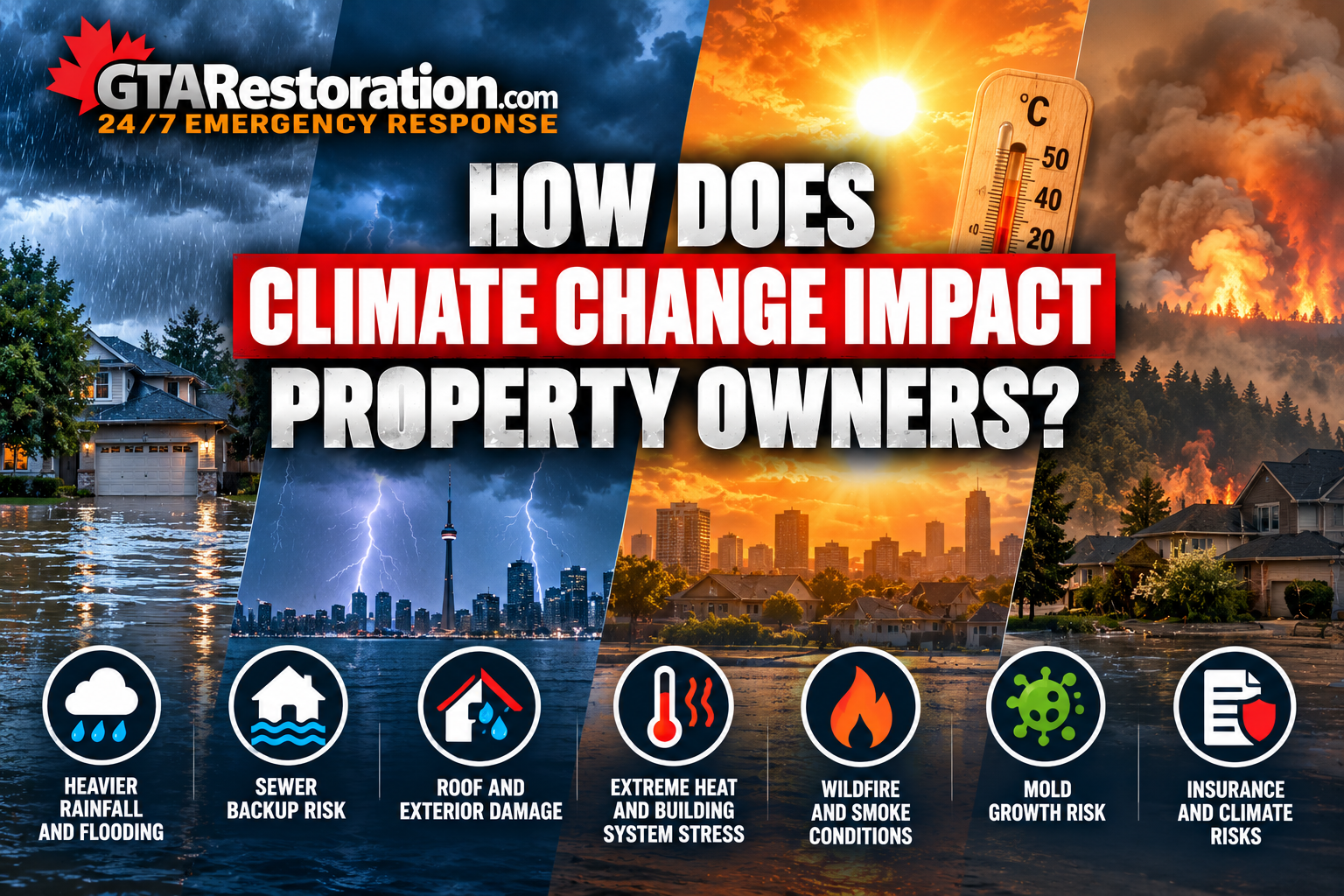
Climate change impacts property owners in several ways, including heavier rainfall, flash flooding, sewer backups, extreme heat and strong storms. Homes and commercial buildings may face more pressure from water entry, roof leaks, drainage problems and indoor moisture. Therefore, preparing before severe weather arrives can help reduce property damage.

Changing weather patterns do not mean every individual storm has the same cause. Still, several weather risks can become more serious as the climate changes. A practical first step is to find weak areas around your property and reduce the chance that rain, flooding or heat turns into major damage.

Climate Change and Flooding Risk

Heavy rain can overwhelm gutters, drains, sump pumps and sewer systems. As a result, water may enter basements, garages and lower levels. Moisture may also move beneath flooring, behind baseboards and into wall cavities before the full extent of the damage becomes visible.

Once flooding occurs, remove standing water as soon as conditions are safe. Nearby walls, flooring and other materials should also be checked for hidden moisture. Professional water damage restoration can include extraction, moisture checks and structural drying when a larger area is affected.

Climate Change and Sewer Backup Risk

Periods of heavy rainfall can place added pressure on drainage and sewer systems. Sewage that enters a property may contain harmful contaminants and should be treated differently from a clean plumbing leak.

To reduce the risk, ask a qualified plumber whether a backwater valve or other flood protection is suitable for the building. Good grading around the property can also help direct rainwater away from the foundation.

If a backup occurs, keep people and pets away from the affected area. Then arrange professional sewer backup cleanup as soon as possible.

Climate Risks for Roofs and Foundations

Climate change impacts can also become visible around roofs, foundations and exterior walls. During heavy rain, weak flashing, damaged roofing, poor seals or foundation cracks may allow water into areas that previously seemed dry.

Routine checks of roofing, gutters, downspouts, windows and exterior drainage can help find problems early. Rainwater should move away from the building instead of collecting beside the foundation.

When hidden water is suspected, water leak detection and moisture inspection can help identify affected areas before repairs begin.

Climate Risks for Homes and Commercial Properties

Climate change impacts on Building System are not limited to flooding. Longer periods of extreme heat can place more demand on cooling and electrical systems.

Before hot weather begins, service air-conditioning equipment and replace filters when needed. Building owners should also confirm that important mechanical systems are working properly. Commercial properties may need an additional plan for occupied spaces if cooling equipment fails.

Climate-Related Water Damage and Mold

Flooding and roof leaks can leave moisture inside drywall, insulation, flooring and wall cavities even after standing water disappears. Damp materials can then create conditions that support mold growth.

For that reason, proper drying is just as important as removing visible water. Avoid painting over water stains or covering damp materials with new finishes.

If recurring stains, musty odours or visible growth appear, our mold removal and remediation service can help assess the moisture source and affected areas.

Climate Risks in Canada

Canada continues to study how warming affects heavy rainfall, flooding, heat and wildfire conditions. Property owners can review current information through the Government of Canada’s Changing Climate Report.

Broader weather risks make regular building maintenance more important. For example, a clogged gutter, aging roof, weak drainage system or unnoticed plumbing leak can cause more damage when severe weather arrives.

Climate Risks and Property Insurance

Another way climate change impacts property owners is through insurance planning. Coverage for sewer backup, overland flooding, roof damage and other water losses can vary from one policy to another.

Before an emergency happens, review your policy with your insurer or broker. Ask specifically about water damage, sewer backup, flooding, storm damage, deductibles and coverage limits.

After a loss, take photos and videos when it is safe. Keep invoices, estimates and other records as well. You can also review our insurance restoration claims guide.

Reduce Climate-Related Property Damage

Reduce Climate-Related Flood Damage

One of the best ways to reduce climate change impacts on a property is to control where water goes. Keep gutters clear, extend downspouts away from the foundation and correct areas where rainwater regularly pools.

Foundation walls should also be checked for cracks or signs of past water entry. Ongoing basement moisture may require professional basement waterproofing to address the source.

Prepare for Flooding With Sump and Backwater Protection

Test the sump pump before periods of heavy rain to make sure it operates correctly. Its discharge line should remain clear and direct water to a suitable location. Where appropriate, backup power can help keep the pump running during an outage.

A qualified plumber can also advise whether backwater protection is suitable for the property.

Reduce Storm Damage to Roofs and Exteriors

After severe weather, inspect roofs and gutters for visible problems. Missing shingles, damaged flashing or blocked drainage can allow water into ceilings, insulation and walls.

Windows and exterior joints also deserve attention. Even a small opening can become a major leak point during wind-driven rain.

Use Leak Sensors to Reduce Water Damage

Smart water sensors can provide early warnings near water heaters, washing machines, sinks and other plumbing areas. Although these devices cannot prevent every flood, they can give property owners more time to respond.

Our guide to the best water leak sensors explains different types and where they can be installed.

Create a Climate Emergency Property Plan

Know where the main water shutoff is located and make sure responsible occupants know how to use it. Emergency contacts should also be easy to find. In addition, decide who will respond if severe weather affects the property.

For condos, rental buildings and commercial properties, clear responsibilities are especially important. Building managers, tenants and contractors may all need to act quickly when water enters more than one area.

Document Property Conditions Before Severe Weather

Current photos of important rooms, equipment and valuable contents can be useful after a property loss. Important insurance information and property records should also remain accessible during an emergency.

Ultimately, climate change impacts make preparation and routine property maintenance more important. No property owner can stop every storm, flood or heat event. However, good drainage, regular inspections, moisture control and fast emergency response can help reduce the amount of damage.


Has Severe Weather Damaged Your Property?

GTA Restoration provides water damage restoration, flood cleanup, sewer backup cleanup, mold remediation and emergency property restoration throughout Toronto and the GTA.

Flood, leak, storm damage or hidden moisture? Get help before the damage spreads farther.

Call Us: 416-800-0000

Learn More

Insurance Documentation for Restoration Claims | Hailstorm Season in Toronto: A Local Guide | Water Extraction vs Drying: What Comes First? | 5 Best Tips for Planning Your Home Renovation | 4 Common Roofing Emergency Questions | Prepare Your House for Heavy Rain
Share this... Spread the word!


Tags: Best Mold Removal Toronto, Climate Change in Toronto Canada, Extreme Weather, Mold Removal, Mold Removal Toronto, Property Owners, Property Protection, Roof Repairs, Sewer Backup, Toronto Extreme Weather, Toronto Real Estate Restoration, Water Damage Toronto, Waterproofing,

☛ ☛ Related Restoration Articles You May Also Like!

Radiant floor heating systems can prevent bathroom mold
How Water Damage Causes Mold Growth
Top 5 Best Water Damage Service Providers in Toronto
⭐⭐⭐⭐⭐ Top 5 Emergency Roof Repair Services in the GTA

Emergency? Immediate response 24/7

416.800.0000 416.800.0000

For non-emergencies use our contact form

Climate Change Impacts and Heavy Rain

Heavy rainfall can overwhelm gutters, drains and sump systems. As a result, water may collect around foundations or enter basements and lower levels. Property owners should keep drainage systems clear and correct areas where water regularly pools near the building.

Reduce Flood and Sewer Backup Risk

Severe rain can also place added pressure on sewer systems. Therefore, property owners should check sump pumps and ask a qualified plumber whether a backwater valve is suitable for the building. Good exterior drainage can also help keep water away from the foundation.

Protect Roofs and Exterior Walls

Storms can expose weak areas around roofing, flashing, windows and exterior seals. Regular inspections can help find small problems before water reaches ceilings, insulation or wall cavities.

Watch for Hidden Water Damage

Water does not always stay in the area where it first enters. Instead, moisture may move beneath flooring, behind walls or through ceilings. Moisture checks can help locate wet materials before repairs begin.

Climate Change Impacts and Mold Risk

Flooding, roof leaks and high indoor moisture can create damp conditions that support mold growth. For this reason, affected materials should be dried properly after water damage rather than simply covered with paint or new finishes.

Prepare Buildings for Extreme Heat

Long periods of hot weather can place extra demand on cooling and electrical systems. Before summer heat arrives, service air-conditioning equipment, replace filters when needed and check that important building systems work properly.

Use Early Water Warnings

Water leak sensors can provide alerts near washing machines, water heaters, sinks and other plumbing areas. Although these devices cannot prevent every water loss, early warnings can give property owners more time to respond.

Review Property Insurance

Insurance coverage for floods, sewer backups and storm damage can vary. Therefore, review your policy with your insurer or broker before an emergency and ask about coverage limits, deductibles and water-related exclusions.

Keep Property Records Current

Take photos of important rooms, equipment and valuable contents before severe weather occurs. In addition, keep insurance information, repair records and emergency contacts somewhere you can access quickly.

Create an Emergency Response Plan

Know where the main water shutoff is located and make sure responsible occupants know what to do. For commercial and multi-unit properties, assign emergency roles before a flood, leak or storm causes damage.

Property Restoration After Severe Weather

GTA Restoration provides emergency water extraction, structural drying, sewer backup cleanup, mold remediation and property restoration throughout Toronto and the GTA. Fast action can help control water and reduce additional damage after severe weather.


Concerned About Flooding, Storm Damage or Hidden Moisture?

Get professional help locating water, drying affected materials and protecting your property from further damage.

Call Us: 416-800-0000


Nationwide, Local Pricing

GTA Restoration offers local flood & water damage repair, mold removal/remediation, asbestos removal/abatement, fire/smoke damage repair services and much more.

Search

  • Ajax Asbestos Removal
  • Ajax Mold Removal
  • Ajax Water Damage
  • Anjou Mold Removal
  • Aurora Mold Removal
  • Aurora Water Damage
  • Beaconsfield Asbestos Removal
  • Beaconsfield Mold Removal
  • Boucherville Mold Removal
  • Brampton Asbestos Removal
  • Brampton Asbestos Removal
  • Brampton Mold Removal
  • Brampton Water Damage
  • Brossard Mold Removal
  • Burlington Asbestos Removal
  • Burlington Mold Removal
  • Burlington Water Damage
  • Burnaby Mold Removal
  • Burst Frozen Pipe Edmonton
  • Caledon Mold Removal
  • Caledon Water Damage
  • Calgary Asbestos Removal
  • Calgary Mold Removal
  • Calgary Water Damage
  • Cambridge Mold Removal
  • Cambridge Water Damage
  • Chambly Mold Removal
  • Chateauguay Mold Removal
  • Chomedey Mold Removal
  • Clarington Mold Removal
  • Concord Mold Removal
  • Concord Water Damage
  • Mississauga Mold Removal
  • Coquitlam Mold Removal
  • Cumberland Mold Removal
  • Dollard-des-Ormeaux Mold Removal
  • Dorval Mold Removal
  • Edmonton Asbestos Removal
  • Edmonton Mold Removal
  • Edmonton Water Damage
  • Etobicoke Asbestos Removal
  • Etobicoke Mold Removal
  • Etobicoke Water Damage
  • McMurray Fire Damage Services
  • Saskatchewan Asbestos Removal
  • Saskatchewan Mold Removal
  • Frozen Burst Pipe Repair Montreal
  • Frozen Burst Pipe Repair Ottawa
  • Gloucester Asbestos Removal
  • Gloucester Mold Removal
  • Hamilton Asbestos Removal
  • Hamilton Asbestos Testing
  • Hamilton Mold Removal
  • Hamilton Water Damage
  • Hampstead Mold Removal
  • Hampstead Water & Flood Damage
  • L'île-Bizard Mold Removal
  • Kahnawake Mold Removal
  • Kanata Asbestos Removal
  • Kanata Mold Removal
  • Kanata Water Damage
  • Kirkland Mold Removal
  • Kitchener Asbestos Removal
  • Kitchener Mold Removal
  • Kitchener Water Damage
  • Lasalle Mold Removal
  • Laval Asbestos Removal
  • Laval Mold Removal
  • Laval Water Damage
  • London Mold Removal
  • London Water Damage
  • Longueuil Mold Removal
  • Longueuil Water Damage
  • Markham Asbestos Removal
  • Markham Mold Removal
  • Markham Water Damage
  • Mississauga Asbestos Testing
  • Mississauga Mold Removal
  • Mississauga Water Damage
  • Montreal Air Duct Cleaning
  • Montreal Asbestos Removal
  • Montreal Asbestos Testing
  • Montreal East Mold Removal
  • Montreal Mold Removal
  • Montreal Water Damage
  • Mount-Royal Mold Removal
  • Nepean Asbestos Removal
  • Nepean Mold Removal
  • Nepean Water Damage
  • New Market Water Damage
  • New Westminster Mold Removal
  • Newmarket Mold Removal
  • North York Mold Removal
  • Oakville Mold Removal
  • Oakville Water Damage
  • Orleans Asbestos Removal
  • Orleans Mold Removal
  • Orleans Water Damage
  • Osgoode Mold Removal
  • Oshawa Mold Removal
  • Oshawa Water Damage
  • Ottawa Air Duct Cleaning
  • Ottawa Asbestos Removal
  • Ottawa Mold Removal
  • Ottawa Vermiculite Removal
  • Ottawa Water Damage
  • Pickering Mold Removal
  • Pickering Water Damage
  • Red Deer Mold Removal
  • Red Deer Water Damage
  • Richmond Hill Mold Removal
  • Richmond Hill Water Damage
  • Richmond Mold Removal
  • Rideau Lakes Mold Removal
  • Rockcliffe Park Mold Removal
  • Roxboro Mold Removal
  • Saint Laurent Mold Removal
  • Saint-Hubert Mold Removal
  • Scarborough Asbestos Removal
  • Scarborough Mold removal
  • Scarborough Water Damage
  • Sewer Backup Edmonton
  • Sewer Backup Montreal
  • Sewer Backup Ottawa
  • Sherwood Park Asbestos Removal
  • Sherwood Park Mold Removal
  • Spruce Grove Asbestos Removal
  • Spruce Grove Mold Removal
  • St. Albert Asbestos Removal
  • St. Albert Mold Removal
  • Ste.Dorothee Mold Removal
  • Surrey Mold Removal
  • Thornhill Mold Removal
  • Toronto & GTA Asbestos Removal
  • Toronto & GTA Mold Removal
  • Toronto Air Duct Cleaning
  • Toronto Water Damage
  • Unionville Mold Removal
  • Unionville Water Damage
  • Vancouver Asbestos Removal
  • Vancouver Mold Removal
  • Vancouver Water Damage
  • Vanier Mold Removal
  • Vaughan Mold Removal
  • Vaughan Water Damage
  • Westmount Mold Removal
  • Whitby Water Damage
  • Woodbridge Asbestos Removal
  • Woodbridge Mold Removal
  • Woodbridge Water Damage
  • Waterproofing
  • Kitchen & Bath Pro
  • Condo Restoration

Main Head Office


Climate Change Impacts – Frequently Asked Questions

How do climate change impacts affect property owners?

Changing weather can increase exposure to heavy rain, flooding, extreme heat, severe storms and other conditions that may damage homes and commercial properties.

Can climate change increase flood risk?

Heavy rainfall can increase flash-flood risk and place more pressure on drainage, sump and sewer systems. Good drainage and flood protection can help reduce property damage.

How can property owners prepare for severe rain?

Keep gutters and downspouts clear, test sump pumps, inspect roofs and foundations, and ask a qualified plumber whether backwater protection is suitable.

Should property owners review their insurance coverage?

Yes. Ask your insurer or broker how the policy handles sewer backup, flooding, storm damage and other water-related losses.

What should I do after severe weather damages my property?

Protect people first, stop active water when it is safe, document visible damage and arrange professional extraction and drying before moisture spreads farther.


We Work Direct with All Insurance Companies

Wᴇ ᴀʀᴇ ᴄᴏᴍᴍɪᴛᴛᴇᴅ ᴏɴ ᴡᴏʀᴋɪɴɢ ᴡɪᴛʜ ᴇᴠᴇʀʏ ɪɴsᴜʀᴀɴᴄᴇ ᴄᴏᴍᴘᴀɴʏ ᴀᴄʀᴏss Cᴀɴᴀᴅᴀ & USA.


In House Financing Available

In House Financing Available

FREE Financing Up To 24 Months NO INTEREST NO MONEY DOWN


Contact Us

Learn more ↴ GTA Restoration Tips

RELATED ARTICLES

  • How To Avoid Sprinkler Water Damage?
  • How To Deal With Floods & Water Damage?
  • Signs of Mould Growth In Your Property?
  • Avoid Mould Damage from Melting Snow
  • How to Prevent Water Damage In Summer
  • Avoid Mold Growth With Proper Air Flow
  • Prevent House Floods from Spring Rains
  • Prevent Frozen Burst Pipes in Winter
  • What To Do on Your Flooded Basement?


follow us on  LinkedIn Instagram Twitter Facebook YouTube


Our Clients

Our Vendor Clients


Affiliates

fully certified


GTA Restoration Toronto

Copyright © 2009 - 2026 All Rights Reserved. Sitemap/Links

LinkedInInstagram Twitter Facebook YouTube

Call Us 416-800-0000

Emergency? Immediate response 24/7

416.800.0000

416.800.0000

We cover all GTA 24/7.

Head Office:
250 Consumers Rd,
#10
Toronto, ON
M2J 4V6,
Open 24 hours

Downtown Office:
1 Toronto St,
#10
Toronto, ON
M5W 1A1,
Open 24 hours

For non-emergencies use our contact form


    Not sure what you need?

    Call us today to find the best product for your situation.

    416-800-0000 416-800-0000

    Head Office:
    101 Lebovic Ave,
    Unit #10
    Scarborough,
    ON, M1L 4T7
    Hours
    24-Hours Open

    Downtown Office:
    250 Yonge Street,
    Unit #1A
    Toronto,
    ON, M5B 2L7
    Hours
    24-Hours Open

    How Does Climate Change Impact Property Owners?

    Get a quote today


      GTA Restoration Assistant 24/7 Emergency Restoration Help
      Hi! I'm GTA Restoration's virtual assistant. How can I help with your property damage today?
      Emergency? Call 416-800-0000