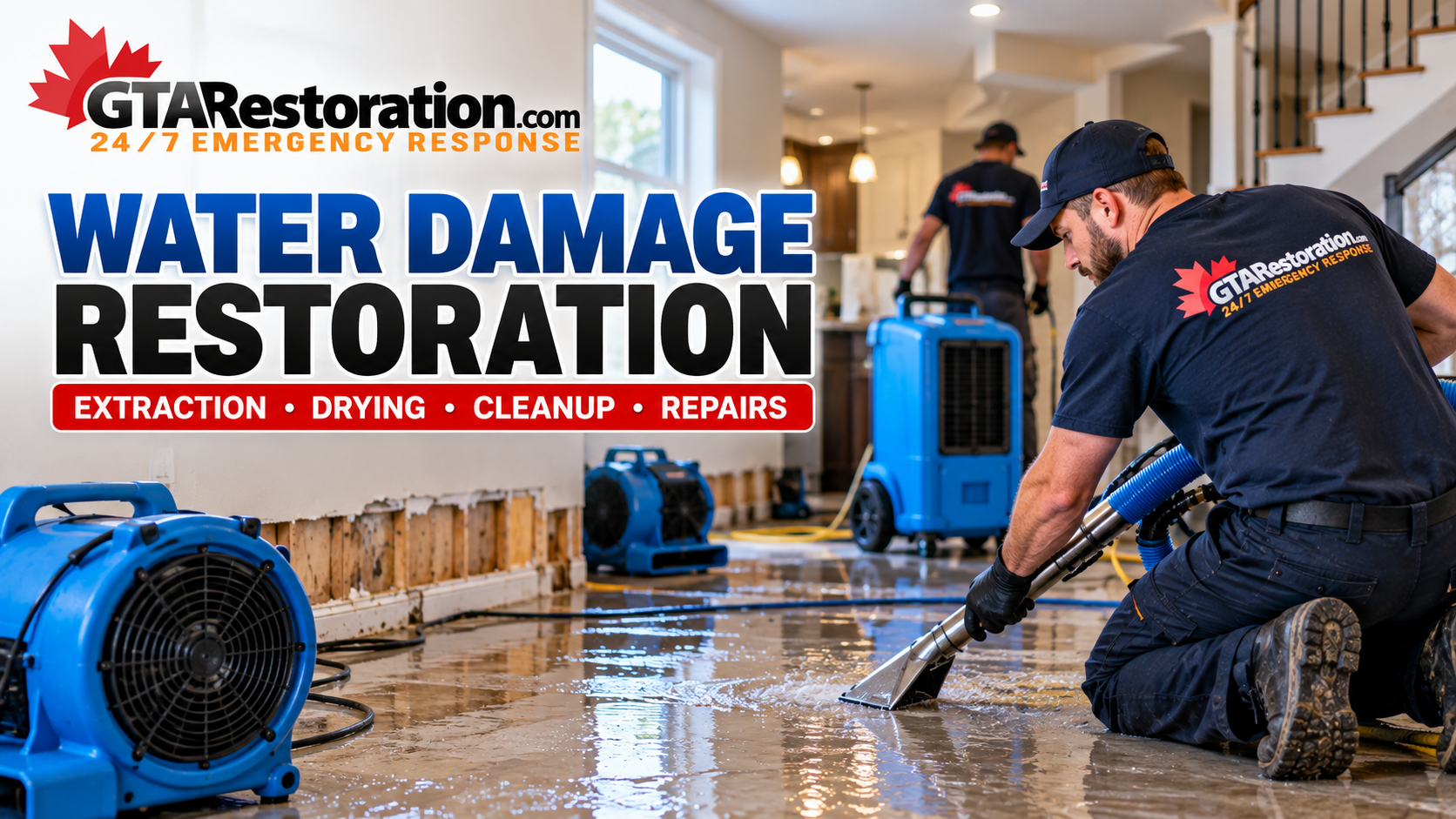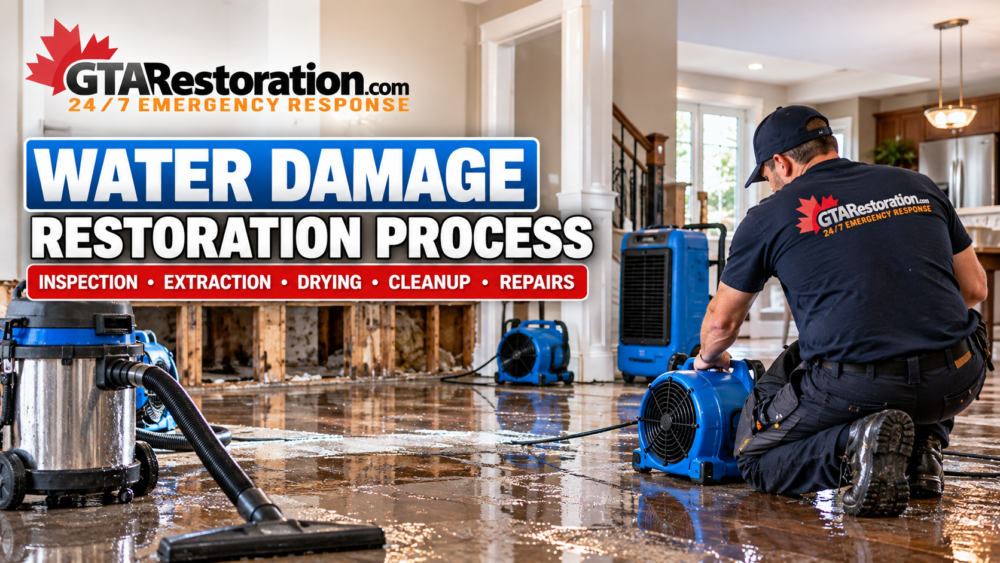
Water damage can affect a home or business with very little warning. For example, a burst pipe, heavy rain, sewer backup, leaking appliance, or roof problem can quickly spread water through flooring, drywall, insulation, ceilings, and personal belongings.
When this happens, water damage restoration helps control the loss, dry the structure, clean affected areas, and prepare the property for repairs.
GTA Restoration provides 24/7 water damage restoration throughout Toronto and the GTA for homeowners, condo owners, landlords, property managers, and commercial properties.
Most importantly, early action can help reduce further damage. The sooner standing water is removed and wet materials are assessed, the better the chance of limiting demolition and protecting materials that may still be saved.
Water does not stay where it first appears.
Instead, it can travel beneath flooring, behind baseboards, inside wall cavities, through ceilings, and into lower levels.
As a result, a small leak can affect a much larger part of the property than expected.
Within a short time, wet materials may begin to swell, stain, warp, or weaken. In addition, prolonged moisture can create conditions that support mold growth.
Therefore, quick water extraction and structural drying are important parts of the restoration process.
Meanwhile, a professional response focuses on stopping the source, removing water, checking for hidden moisture, and protecting unaffected areas.
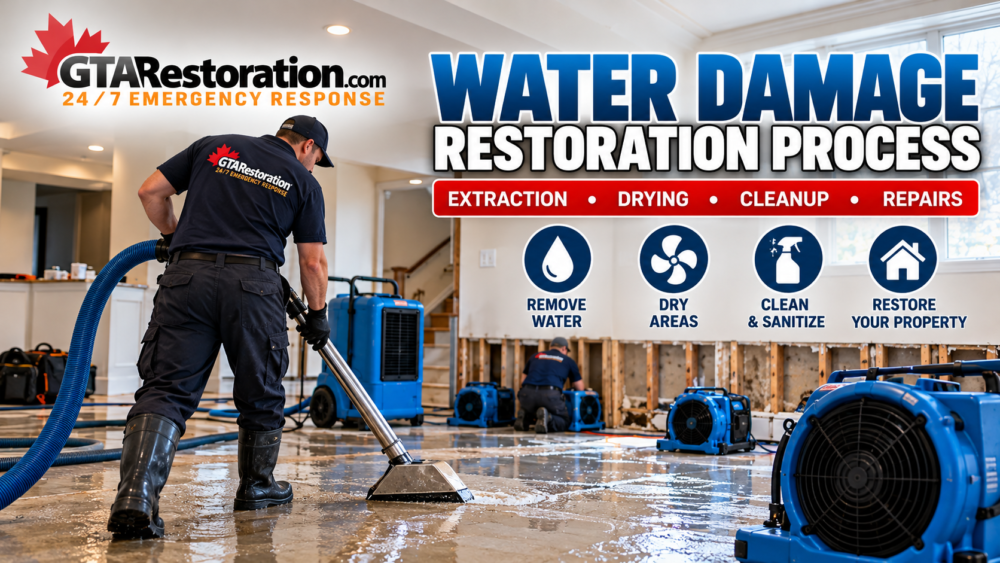
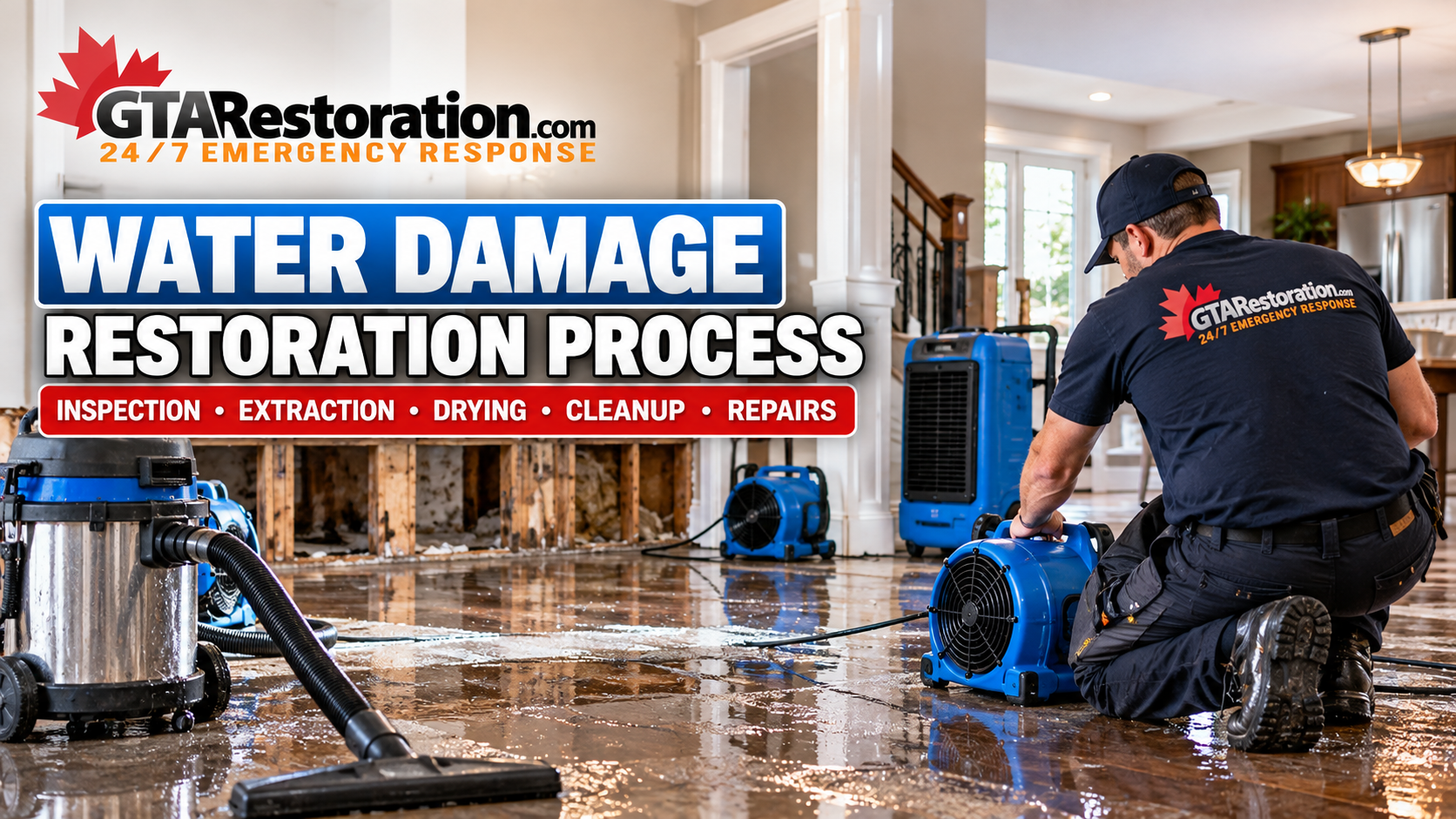
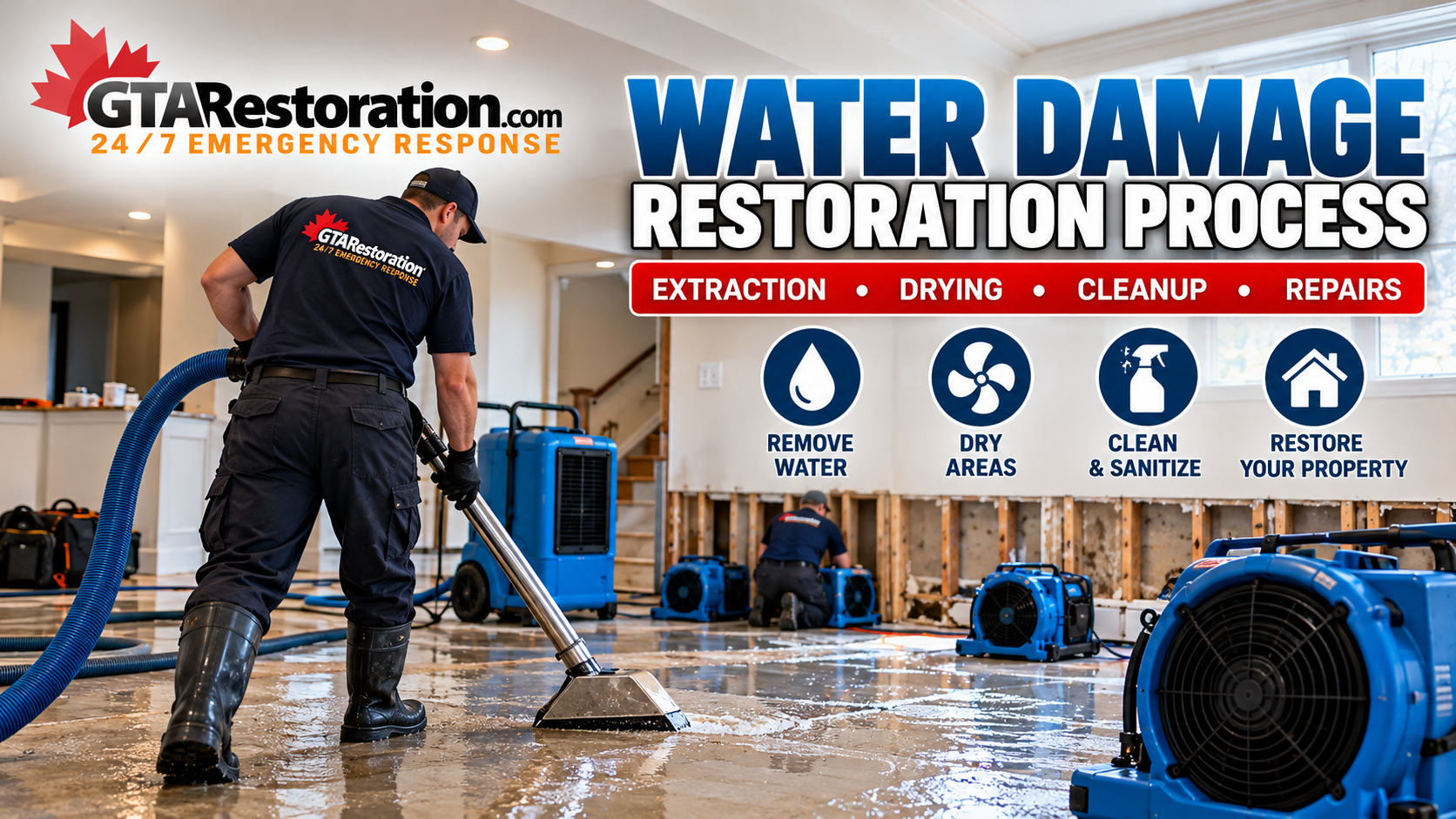
Professional water damage restoration usually follows a clear process.
Although every loss is different, the main stages often include:
Inspection and damage assessment
Water extraction
Moisture detection
Structural drying and dehumidification
Cleaning and sanitizing
Removal of damaged materials when necessary
Repairs and reconstruction
Each stage has a specific purpose.
The goal is not simply to make the property look dry. Instead, restoration should address both visible water and moisture that may remain inside building materials.
For this reason, each stage should be completed according to the actual conditions at the property.
The process starts with an inspection.
First, technicians identify the source of the water and determine which areas are affected.
They may inspect:
Flooring
Walls
Ceilings
Baseboards
Cabinets
Insulation
Subfloors
Contents
Rooms below the original source
In addition, the restoration team checks for safety concerns such as electrical hazards, contaminated water, unstable ceilings, or damaged materials.
The source of the water also matters.
For example, a fresh supply-line leak requires a different response from sewage or other contaminated water.
Therefore, the inspection helps determine the safest and most effective restoration plan.
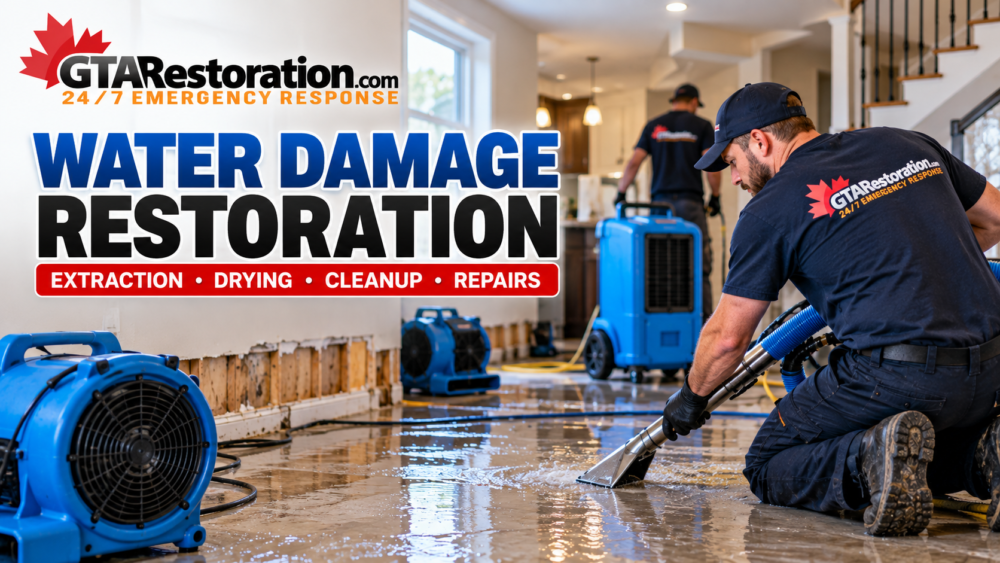
Once the area is safe, standing water should be removed quickly.
Professional pumps, vacuums, and extraction equipment can remove large amounts of water much faster than household tools.
As a result, less water remains available to soak deeper into flooring, drywall, insulation, and other materials.
However, extraction is only the beginning.
Even after visible water is gone, moisture may remain underneath flooring or inside walls.
For this reason, the next step is identifying where that hidden moisture has travelled.
Hidden moisture is one of the biggest concerns after a water loss.
For example, a floor may feel dry while the underlayment remains wet.
Likewise, a wall may show only a small stain even though moisture has spread inside the cavity.
Professional technicians may use:
Moisture meters
Humidity readings
Thermal imaging when appropriate
Direct inspection
These tools help locate affected materials and guide the drying plan.
Therefore, moisture detection helps prevent areas from being missed during restoration.
In addition, accurate moisture information can help technicians decide which materials may be dried and which require further attention.
After extraction, structural drying begins.
Depending on the loss, technicians may use:
Air movers
Commercial dehumidifiers
Moisture meters
Humidity monitoring
Air filtration equipment when appropriate
Specialty drying systems
During this stage, moisture levels are checked regularly.
As materials dry, equipment may be repositioned or removed.
For example, drywall may dry at a different rate from hardwood, concrete, insulation, or subflooring.
Therefore, professional drying is based on moisture readings rather than simply leaving fans in place for a set number of days.
As a result, the drying setup can change as conditions improve.
Cleaning requirements depend on the source of the water.
For instance, a clean-water plumbing leak may require relatively simple cleaning.
In contrast, sewer backups and contaminated water may require additional precautions.
Depending on the situation, services can include:
Surface cleaning
Disinfection
Odour treatment
Containment
Air filtration
Contents cleaning
Removal of contaminated materials
In addition, affected areas may require cleaning after demolition or drying.
Therefore, the cleaning plan should match the actual conditions and contamination level.
Ultimately, the goal is to leave the space clean and ready for the next stage of restoration.
Not every wet material needs to be removed.
In some situations, materials can be dried successfully in place.
However, severe saturation, contamination, or permanent damage may make removal necessary.
Possible removal items include:
Drywall
Wet insulation
Carpet underpad
Laminate flooring
Baseboards
MDF materials
Cabinet components
Other damaged porous materials
In addition, selective removal can expose hidden wet areas and improve drying.
As a result, technicians can focus on removing what is necessary without creating unnecessary rebuilding work.
Once the affected areas are dry and ready for repairs, restoration can begin.
Depending on the loss, repair work may include:
Drywall replacement
Insulation
Painting
Flooring
Baseboards and trim
Cabinetry
Ceiling repairs
Other finish work
For smaller losses, repairs may be limited.
However, larger water events can require more extensive reconstruction.
For this reason, a coordinated restoration process can help reduce delays between emergency cleanup and final repairs.
Water damage can happen for many reasons.
For example, some of the most common causes include:
Burst pipes
Leaking plumbing lines
Sewer backups
Heavy rain
Basement flooding
Roof leaks
Appliance failures
Washing machine leaks
Dishwasher leaks
Water heater failures
Sump pump problems
Foundation seepage
HVAC condensation
Sprinkler discharges
In addition, water damage may develop slowly from a hidden leak.
For this reason, unusual stains, damp areas, musty odours, or recurring moisture should not be ignored.
Ultimately, early detection can help prevent a minor issue from becoming a larger restoration project.
Not every water loss should be treated the same way.
For example, a fresh supply-line leak may begin as relatively clean water.
However, sewage, drain water, and certain types of floodwater can contain harmful contaminants.
As a result, contaminated water may require:
Protective equipment
Containment
Controlled material removal
Cleaning
Disinfection
Air filtration
Safe disposal procedures
Therefore, knowing where the water came from is an important part of choosing the correct cleanup method.
In addition, the condition of the water can affect which materials are suitable for cleaning and which may require removal.
A small spill may sometimes be manageable with basic cleanup.
However, larger water losses often involve more than visible water.
For instance, moisture can remain:
Under flooring
Behind walls
Inside ceilings
In insulation
Beneath cabinets
In subflooring
Household fans may help in a minor clean-water incident. However, they do not replace professional moisture detection and dehumidification when building materials are saturated.
In addition, contaminated water requires proper safety procedures.
Therefore, professional restoration technicians use equipment, training, and monitoring to address the actual conditions of the property.
As a result, decisions about drying and material removal can be based on measured conditions rather than appearance alone.
Condo and commercial water losses can be more complicated than a single-room residential leak.
For example, water from one condo unit may spread into:
The unit below
Shared walls
Hallway ceilings
Common elements
Building systems
Meanwhile, commercial losses may affect:
Employees
Tenants
Customers
Inventory
Equipment
Business operations
As a result, the restoration process may require coordination with property management, building staff, insurers, and other contractors.
In addition, after-hours access, elevators, parking, security, and tenant communication can affect the response.
Therefore, clear communication and documentation become especially important in these larger losses.
Water damage often becomes an insurance claim.
Therefore, good documentation can help explain what happened and what emergency work was necessary.
For example, a professional restoration file may include:
Photos
Moisture readings
Affected-area notes
Equipment records
Drying logs
Material removal records
Cleaning documentation
Scope-of-work information
In addition, plumbing reports or other source documentation may help explain the cause of the loss.
However, restoration companies do not determine whether a claim is covered.
Ultimately, your insurer makes the final decision based on your policy, cause of loss, deductible, limits, exclusions, and endorsements.
Not every water emergency can be prevented.
However, regular maintenance can reduce the risk.
For example, consider:
Inspecting aging plumbing
Replacing damaged supply hoses
Checking appliances for leaks
Testing sump pumps
Cleaning roof drainage systems
Repairing roof leaks quickly
Watching for foundation seepage
Insulating vulnerable pipes
Knowing the location of the main water shutoff
Checking vacant properties regularly
In addition, pay attention to early warning signs.
For instance, water stains, damp drywall, warped flooring, unusual humidity, or musty odours may indicate a hidden issue.
As a result, addressing these problems early can help prevent a larger loss.
If water is entering your property right now, focus on safety first.
First, keep people and pets away from standing water.
If it is safe, shut off the water source.
Most importantly, avoid electrical hazards. Never enter standing water near outlets, appliances, or electrical panels.
If contamination is suspected, stay away from sewage or affected water.
When conditions allow, move valuables to a dry area.
Next, take photos before major cleanup begins.
If you plan to make a claim, contact your insurer promptly.
Finally, arrange professional water extraction and drying.
If there is an immediate electrical, fire, structural, or other life-safety hazard, contact emergency services first.
Water damage can become more serious when it is left untreated.
Therefore, if water is spreading through your home, condo, rental property, or commercial building, do not wait for the area to dry on its own.
GTA Restoration provides 24/7 water damage restoration throughout Toronto and the GTA.
Our emergency team can assess affected areas, remove standing water, locate hidden moisture, set up structural drying equipment, document the loss, and coordinate the next stages of recovery.
In addition, our team can explain the restoration process and what should happen next based on the conditions found at your property.
Tell us what happened, where the water is coming from if known, and which areas are affected. From there, our emergency team can explain the immediate next steps.
For non-emergencies use our contact form
Water damage strikes without warning and upends a house or business in a matter of minutes. Burst pipes, torrential rains, sewer backups, and malfunctioning appliances can wreak havoc with water intrusion. For this reason, when property owners are faced with the anger of losing their structures and security, restoration from water damage is ranked highly, if not on top.
The longer someone delays or postpones the understanding of the restoration processes involved and their necessity to be performed; the greater the chances for deteriorating conditions of mold infection, structural damage, and spiraling repair costs to become potential issues of serious concerns thereafter. With an efficient restoration manpower team carrying out the water damage restoration, the process will do its part to differentiate between your property being restored back to its original state and restoring your peace of mind and sense of comfort.
Time is critical when it comes to water: it travels through floors, walls, and insulating materials, soaking personal belongings. In just a few hours, the water will be weakening construction materials, swelling timber, and setting perfect conditions for mold growth. A few days of delay will thereby increase exponentially the cleanup duration and inflate repair costs.
Time starts the moment water makes its entry. Trained professional restorers will respond to the call very quickly, remove standing water, and stop it from further damage. A quick response is the key toward preventing losses that may take place within the interim before the property is secured for occupancy once again.
The actual process of water damage restoration is timely, labor-intensive, and scientific for a reason: to remove water, dry the building, treat the area, and restore materials that could not be saved otherwise. Each one of the steps plays a large part in correctly eliminating any contamination, destruction, or both from the house or company at the earliest.
Part one of the processes deals with the inspection of the building and its entire assessment. Using the inspection process, the professionals will be able to analyze how far the water flowed, state the origin of water, and classify the degree of contamination. It is this classification that will give the level of safety versus the hazardous effect of a course of action for restoring comfort and peace of mind.
Water extraction holds priority; the sooner the better. Industrial pumps and vacuums are used to suck out water and prevent deeper penetration into flooring and walls. The fastest possible extraction will ensure little possibility of further deterioration and mold infestation.
Thus far, the visible water has been removed, but hidden moisture could still remain within the building materials. Our professionals put dehumidifiers and high-velocity air movers in place, as well as moisture-activated meters functioning together for optimal drying. Properly drying out prevents weakness in construction and denies molding the damp environment that it is used to.
With water damage comes the invasion of bacteria, dirt, and awful smells into your property. The restoration companies do all the comprehensive cleaning and sanitizing of the walls, floors, furniture, and belongings with various cleaning solutions. Antimicrobial treatments would then be used to prevent mold and thus make the area safe.
The last step involves repairs or replacement of damaged materials. These may include drywall replacement, floor repairs, painting, and possible reconstruction of affected structural components. The objective is always to restore it back to its original condition to make it look and feel as if no disaster ever happened.
Familiarity with the causes of water damage aids you in averting their occurrences via preventive measures. The most common causes are as follows:
Early detection of these hazards can provide good defense against the threat of catastrophic damage.
Though restoration looks easy when attempting it alone, the water damage restoration becomes highly technical and complicated. Mistaken or improper cleaning or drying procedures may create channels that would allow hidden moisture to remain trapped behind walls, etc., and may eventually lead to mold growth, structural bias, and even health hazards. Experts arrive on the job with advanced equipment and scientific methods to do it correctly and to remove future risk.
Apart from the technicalities, restoration services also provide comfort in knowing that your property is in expert hands, that any concealed problems will not stay concealed for long, and that your property will return to its original state.
Water damage can bring sorrow; however, with the right people and plans, recovery can be complete, and protection against future recurrence is ensured. Routine maintenance, timely repairs, and preventive measures can drop any chances of having water come back in.
Water damage restoration can quickly turn from a stressful ordeal into a near-scientific recovery process with guaranteed success if taken up by well-versed professionals. It ensures that you get back to your normal life while regaining all that you have lost.
Nationwide, Local Pricing
GTA Restoration offers local flood & water damage repair, mold removal/remediation, asbestos removal/abatement, fire/smoke damage repair services and much more.
Search
For Tips on Water Damage and Emergency Plumbing
We Work Direct with All Insurance Companies
Wᴇ ᴀʀᴇ ᴄᴏᴍᴍɪᴛᴛᴇᴅ ᴏɴ ᴡᴏʀᴋɪɴɢ ᴡɪᴛʜ ᴇᴠᴇʀʏ ɪɴsᴜʀᴀɴᴄᴇ ᴄᴏᴍᴘᴀɴʏ ᴀᴄʀᴏss Cᴀɴᴀᴅᴀ & USA.
Learn more ↴
RELATED ARTICLES
Emergency? Immediate response 24/7
We cover all GTA 24/7.
Head Office:
250 Consumers Rd,
#10
Toronto, ON
M2J 4V6,
Open 24 hours
Downtown Office:
1 Toronto St,
#10
Toronto, ON
M5W 1A1,
Open 24 hours
For non-emergencies use our contact form
Not sure what you need?
Call us today to find the best product for your situation.
Head Office:
101 Lebovic Ave,
Unit #10
Scarborough,
ON, M1L 4T7
Hours
24-Hours Open
Downtown Office:
250 Yonge Street,
Unit #1A
Toronto,
ON, M5B 2L7
Hours
24-Hours Open
Water Damage Restoration: Protecting Your Property and Restoring Peace of Mind
Get a quote today