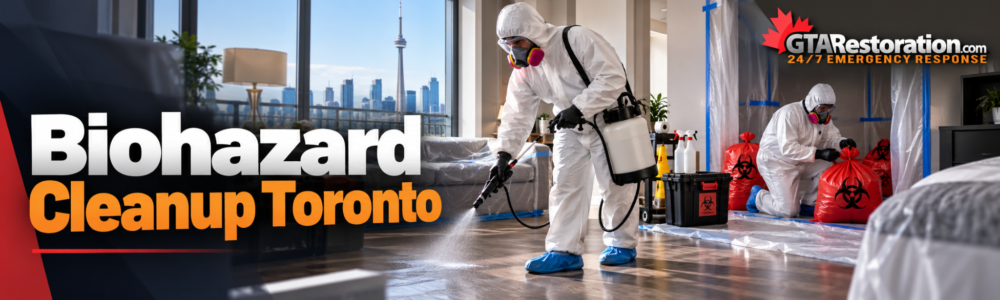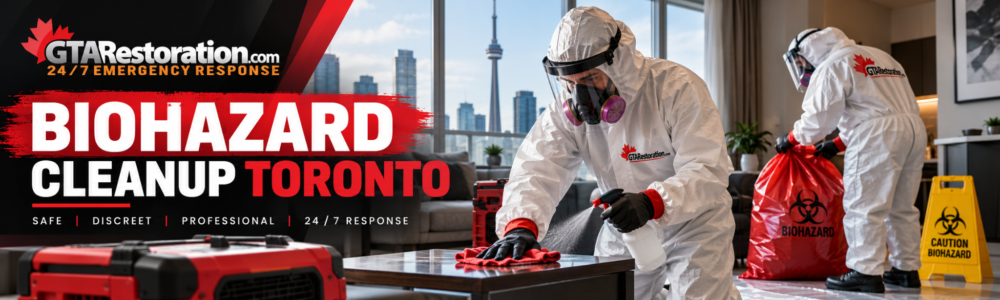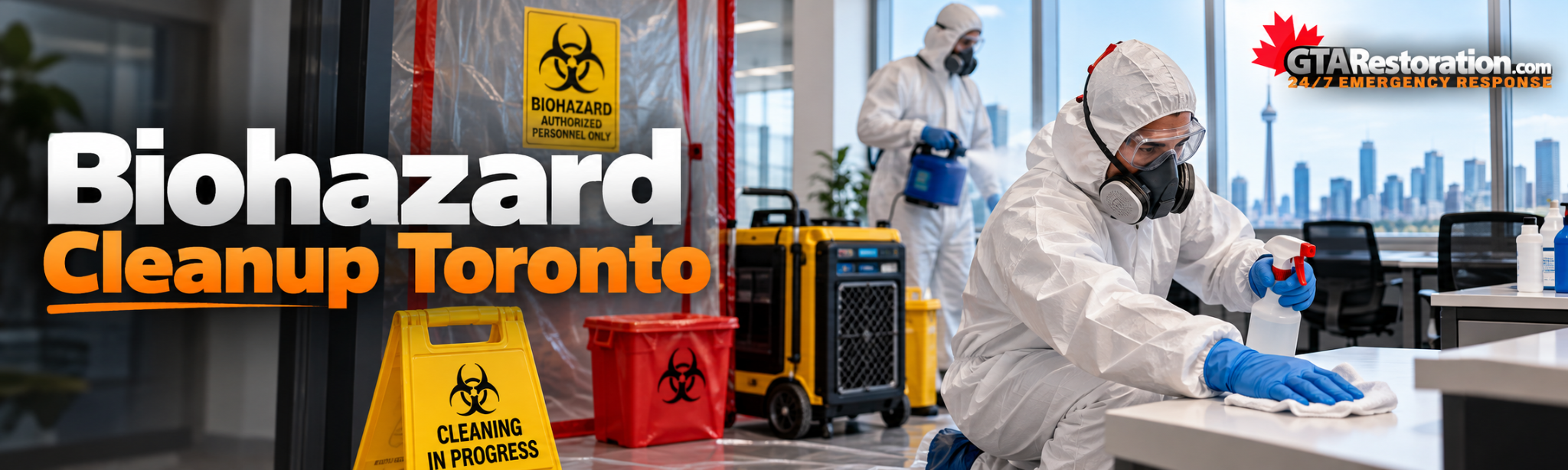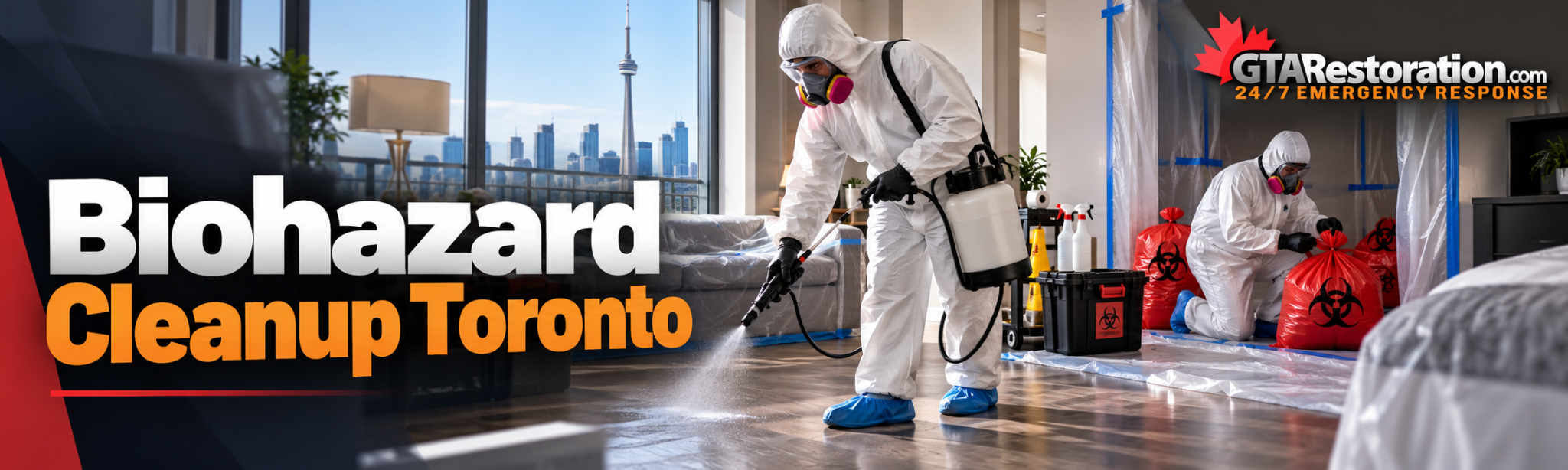
Biohazard contamination requires careful handling, proper cleaning procedures, and appropriate safety precautions. GTA Restoration provides professional biohazard cleanup in Toronto for homes, condominiums, apartment buildings, businesses, and other properties throughout the Greater Toronto Area.
Our team responds to situations involving blood, bodily fluids, trauma scenes, unattended deaths, human waste, animal contamination, and other potentially hazardous materials. In addition, we approach sensitive situations with discretion and respect for property owners, families, tenants, and building occupants.
Because every biohazard situation is different, our technicians first assess the affected area and determine an appropriate cleanup plan. Then, depending on the conditions, the work may involve containment, removal of contaminated materials, detailed cleaning, disinfection, odour remediation, and other restoration procedures.
Need immediate biohazard cleanup in Toronto? Call GTA Restoration 24/7 at 416-800-0000.
A biohazard situation can occur unexpectedly in almost any type of property. For example, an accident may leave blood or bodily fluids on flooring and building materials. Similarly, an unattended death can result in biological contamination and persistent odours that extend beyond the immediately visible area.
Therefore, biohazard cleanup involves more than ordinary household cleaning. Depending on the situation, contaminated porous materials may require removal, while other surfaces may be suitable for detailed cleaning and disinfection.
In addition, sharps and certain blood-contaminated materials can require specific handling and disposal procedures. Ontario guidance recognizes human blood waste and sharps waste as biomedical waste in specified circumstances and provides requirements and best practices for segregation, containment, handling, transportation, treatment, and disposal. citeturn0search0turn0search4
For this reason, GTA Restoration evaluates the contamination before determining the appropriate scope of work.
Biohazard cleanup is the controlled cleaning and remediation of areas affected by biological materials or other potentially hazardous contamination. The goal is to address the source, remove materials that cannot be adequately cleaned, clean and disinfect appropriate surfaces, and restore the affected area as required.
However, not every situation requires exactly the same procedures. The appropriate approach depends on the source of contamination, the amount involved, the affected materials, the size of the area, and other site conditions.
For example, contamination on a hard, non-porous surface may require a different approach from contamination that has entered carpet, underpad, drywall, wood, furniture, or other porous materials. Therefore, technicians should assess both the visible contamination and surrounding areas that may have been affected.
GTA Restoration provides Toronto biohazard cleanup for a variety of residential and commercial situations. Depending on the property and conditions, our team can assist with the following types of cleanup.
Blood and certain bodily fluids require appropriate precautions because exposure can present health concerns. Toronto Public Health advises people who believe they have experienced certain body-fluid exposures to contact a medical professional promptly for risk assessment and guidance. citeturn0search2turn0search3
Therefore, property occupants should avoid unnecessary contact with contaminated materials. During professional cleanup, technicians assess the affected surfaces and determine which materials can be cleaned and which may require removal.
In addition, contamination can sometimes extend beyond the obvious stain. For this reason, surrounding flooring, walls, furniture, and other materials may also require inspection.
After a serious accident or traumatic event, property owners should not have to manage biological contamination themselves. Instead, a professional cleanup team can handle affected materials while maintaining privacy and discretion.
First, technicians assess the affected area. Next, access can be controlled where necessary. Afterward, contaminated materials are addressed according to their condition and the type of surface involved.
Finally, appropriate areas can be cleaned, disinfected, deodorized, and prepared for additional restoration when required.
An unattended death can create complex cleanup conditions. Over time, decomposition-related fluids and odours may affect flooring, subflooring, furniture, drywall, contents, and other porous materials.
Therefore, cleaning only the visible surface may not address the complete problem. Instead, technicians may need to investigate where contamination has travelled and determine which affected materials require removal.
In addition, decomposition can create strong and persistent odours. Consequently, odour remediation may form an important part of the restoration process after contaminated materials have been addressed.
After police or other authorities release a property, professional cleanup may be required before normal use can resume. Depending on the event, the scene may contain blood, bodily fluids, fingerprint-processing materials, damaged building materials, or other contamination.
GTA Restoration can assess the affected areas and develop an appropriate cleanup plan. Moreover, our team understands that these situations require discretion and respectful communication.
Human waste contamination can occur after plumbing failures, sanitation problems, hoarding situations, accidents, or other events. Therefore, unnecessary contact should be avoided until the affected area can be properly assessed.
Depending on the conditions, cleanup may involve removal of waste, disposal of unsalvageable materials, cleaning, disinfection, and odour treatment. In addition, porous materials may require further evaluation when contamination has penetrated beneath the surface.
Animal waste, carcasses, nesting materials, urine, feces, and other biological contamination can create significant odour and sanitation concerns. For example, contamination may occur in attics, basements, crawl spaces, vacant properties, or areas where animals have gained access.
First, the source should be addressed. Then, contaminated materials can be evaluated and removed when necessary. Afterward, cleaning and odour remediation can proceed based on the affected surfaces and conditions.
Hoarding situations can involve much more than excessive contents. In some properties, technicians may encounter spoiled food, human or animal waste, insects, odours, mold, sharps, or other potentially hazardous materials.
Therefore, the cleanup process should be based on the actual conditions rather than simply removing contents. In addition, some situations may require coordination with property managers, family members, authorized representatives, or other professionals.
Needles and other sharps should be handled carefully because they can cause puncture injuries and potential exposure to blood or bodily fluids. Ontario’s biomedical-waste guidance specifically identifies certain needles, syringes, blades, and similar contaminated materials as sharps waste. citeturn0search0
Consequently, loose sharps should not be handled casually or placed where they can injure occupants, cleaners, or waste handlers.
Every property requires an individual assessment. Nevertheless, professional biohazard cleanup in Toronto generally follows several important stages.
First, our team assesses the affected area and identifies visible contamination. In addition, technicians consider the materials involved and whether contamination may have spread beyond the immediately visible area.
As a result, the initial assessment helps establish an appropriate scope of work.
Next, access to the work area may be restricted when necessary. Depending on the conditions, technicians can also establish appropriate work practices and use personal protective equipment.
Ontario workplace rules require employers to take measures reasonably necessary to protect workers from exposure to hazardous biological or chemical agents. Those measures can include engineering controls, work practices, hygiene practices, and applicable personal protective equipment. citeturn0search1
Some materials may be suitable for cleaning, while others may require removal. For example, contamination that has penetrated deeply into certain porous materials can be difficult to address through surface cleaning alone.
Therefore, technicians evaluate affected materials according to their condition and the nature of the contamination. When removal is necessary, the materials are handled according to the applicable procedures for the situation.
After affected materials have been addressed, remaining surfaces can be cleaned to remove visible soil and contamination. This step is important because effective disinfection generally requires appropriate surface preparation.
In addition, technicians pay attention to surrounding areas that may have been affected by splashes, contact, or movement through the contaminated space.
After cleaning, appropriate surfaces may be disinfected using products and procedures suitable for the contamination and material involved. Toronto Public Health guidance for blood and body-fluid spills similarly distinguishes cleaning from the subsequent disinfection step and emphasizes following the disinfectant manufacturer’s required contact time. citeturn0search24
Therefore, simply spraying a product and immediately wiping it away may not provide the intended result.
Some biohazard situations create persistent odours. However, odour treatment should not replace removal of the contamination source.
Instead, source removal and cleaning come first. Afterward, additional odour remediation methods may be used when appropriate. Consequently, the treatment addresses the underlying cause rather than simply masking the smell.
Finally, technicians review the affected area and completed work. If damaged building materials were removed, additional repairs or reconstruction may be necessary before the property returns to normal use.
Therefore, biohazard remediation and reconstruction may be separate stages of the overall restoration project.
Cleaning visible contamination does not necessarily mean the entire affected area has been addressed. For example, fluids can enter seams in flooring, absorb into porous materials, travel beneath baseboards, or affect contents that were in contact with the contaminated area.
Furthermore, cleanup workers may encounter sharps or other hazards that are not immediately visible. Therefore, professional assessment helps establish a more controlled approach to the cleanup.
Proper waste handling is also important. Ontario’s biomedical-waste guidance explains that covered biomedical waste should be segregated and managed using appropriate containment, labelling, storage, transportation, treatment, and disposal practices. citeturn0search0turn0search4
Biohazard incidents can occur in houses, condominiums, apartments, rental properties, and other residential settings. Moreover, these events often involve sensitive personal circumstances.
For this reason, GTA Restoration approaches residential biohazard cleanup with discretion. When appropriate, our team can also communicate with property managers, landlords, condominium representatives, insurers, or other authorized parties involved with the property.
In multi-unit buildings, contamination may also affect neighbouring building materials or common areas. Therefore, coordination may be required when the affected area extends beyond a single unit.
Businesses and commercial properties may also require professional biohazard remediation. GTA Restoration can assist offices, retail properties, apartment buildings, commercial facilities, property management companies, and other organizations throughout Toronto and the GTA.
For example, commercial cleanup may be required after an accident, vandalism, blood contamination, human waste incident, or other biological contamination. In addition, property managers may require documentation and coordination with building representatives.
Because commercial properties have different operational requirements, the scope of work depends on access, affected materials, contamination, occupancy, and site conditions.
Some biohazard cleanup situations may involve an insurance claim. Therefore, photographs, work records, invoices, and other restoration documentation may be useful during the claims process.
However, coverage depends on the individual insurance policy and circumstances of the loss. GTA Restoration cannot determine whether a particular cleanup will be covered. Instead, the insurance company makes that decision according to the policy, cause of loss, limits, exclusions, and deductible.
Meanwhile, emergency cleanup may still be necessary to protect the property and control access to affected areas. For this reason, property owners should report the incident promptly when they intend to make a claim.
Property managers and landlords may discover biohazard contamination after a tenant incident, welfare check, accident, unauthorized occupancy, hoarding situation, or other event.
First, restrict unnecessary access when potentially hazardous contamination is present. Next, document the visible conditions when it is safe and appropriate. Then, arrange for professional assessment and cleanup.
In addition, keeping clear records of the work can help property managers document what occurred and what remediation was completed.
If you discover blood, bodily fluids, human waste, needles, decomposition-related contamination, or another potential biohazard, avoid unnecessary contact. Instead, keep other people and pets away from the affected area when it is safe to do so.
Next, do not handle loose sharps with bare hands. Likewise, avoid moving contaminated porous materials through clean areas without appropriate precautions. If someone has experienced a needlestick or significant body-fluid exposure, Toronto Public Health advises contacting a medical professional immediately for assessment. citeturn0search2turn0search3
Finally, contact a professional biohazard cleanup company when the contamination requires specialized handling, removal, cleaning, disinfection, or disposal.
Once authorities have released the area and it is safe for cleanup to begin, arranging an assessment promptly can help prevent unnecessary access and determine which materials have been affected. However, emergency services or law enforcement requirements always take priority when they are involved.
The appropriate response depends on the amount of blood, the affected material, and the circumstances. A small surface spill is different from extensive contamination affecting porous building materials. Therefore, significant contamination or situations involving unknown hazards may require professional cleanup.
It depends on the contamination and conditions. Some situations may allow appropriate cleaning, while others may require removal of carpet, underpad, or other affected materials. Consequently, the decision should be based on the actual conditions rather than appearance alone.
Odour remediation can form part of biohazard cleanup. However, the contamination source should be addressed first. Afterward, additional odour treatment may be appropriate depending on the materials and conditions.
Yes. GTA Restoration provides cleanup for unattended death and decomposition-related contamination as part of our Toronto biohazard remediation services. The required scope depends on the affected materials and extent of contamination.
GTA Restoration can provide post-incident cleanup after the appropriate authorities have released the property. Depending on the situation, cleanup may involve blood, bodily fluids, contaminated materials, cleaning, disinfection, and odour remediation.
Yes. We provide biohazard cleanup for residential and commercial properties throughout Toronto and surrounding GTA communities. In addition, we can coordinate with authorized property managers and building representatives when required.
GTA Restoration provides biohazard cleanup in Toronto and the Greater Toronto Area. Our service area includes Toronto, North York, Scarborough, Etobicoke, Mississauga, Brampton, Vaughan, Markham, Richmond Hill, and surrounding GTA communities.
Whether the affected property is a house, condominium, rental unit, office, apartment building, or commercial facility, our team can assess the situation and determine the appropriate cleanup approach.
Biohazard situations require careful work and clear communication. Therefore, GTA Restoration focuses on assessing the actual conditions before determining what needs to be cleaned, removed, disinfected, or restored.
When a property contains blood, bodily fluids, decomposition-related materials, human waste, sharps, or another potential biohazard, avoid unnecessary contact with the affected area. Instead, restrict access when it is safe to do so and arrange for professional assistance.
GTA Restoration provides 24/7 biohazard cleanup Toronto services for residential and commercial properties throughout Toronto and the GTA. From the initial assessment through cleanup, disinfection, odour remediation, and restoration, our team can help determine the appropriate next steps for the property.
Need professional biohazard cleanup now? Call GTA Restoration 24/7 at 416-800-0000.
Toronto Biohazard Cleanup & Remediation Services, The Process of Biohazard Cleanup and Remediation, Different Types of Biohazardous Waste, Vancouver Biohazard Cleanup, Water Damage Toronto Mold Removal | GTA Restoration For non-emergencies use our contact form
Biohazard contamination can affect homes, condos, rental properties, offices, and commercial buildings. Blood, bodily fluids, human waste, decomposition, and other biological materials may also reach flooring, walls, furniture, and other porous materials.
Therefore, GTA Restoration provides professional biohazard cleanup in Toronto based on the conditions found at the property. Our team assesses the affected area, removes contaminated materials when necessary, and cleans and disinfects appropriate surfaces.
Blood, bodily fluids, trauma incidents, and unattended deaths require careful cleanup. In addition, decomposition-related contamination may extend beneath flooring or into other porous materials and create persistent odours. As a result, remediation may include material removal, detailed cleaning, disinfection, and odour treatment.
GTA Restoration provides biohazard cleanup for condos, rental properties, offices, retail spaces, apartment buildings, and other commercial facilities. When necessary, our team can also coordinate with property managers, landlords, condominium representatives, and other authorized parties.
Effective remediation starts by addressing the contamination source. Next, affected materials are removed or cleaned as appropriate. Then, suitable surfaces can be disinfected. If odours remain, additional odour remediation may also be required.
Professional assistance should be considered for significant blood or bodily fluids, decomposition, human waste, sharps, trauma-related contamination, or other conditions that cannot be managed through ordinary cleaning. Meanwhile, avoid unnecessary contact with affected areas and never handle loose needles with bare hands.
GTA Restoration provides 24/7 biohazard cleanup Toronto services for residential and commercial properties throughout Toronto, North York, Scarborough, Etobicoke, Mississauga, Brampton, Vaughan, Markham, Richmond Hill, and surrounding GTA communities.
Need immediate assistance? Call GTA Restoration at 416-800-0000 for 24/7 biohazard cleanup in Toronto and the GTA.
Nationwide, Local Pricing
GTA Restoration offers local flood & water damage repair, mold removal/remediation, asbestos removal/abatement, fire/smoke damage repair services and much more.
Search
Biohazard Cleanup Toronto
We Work Direct with All Insurance Companies
Wᴇ ᴀʀᴇ ᴄᴏᴍᴍɪᴛᴛᴇᴅ ᴏɴ ᴡᴏʀᴋɪɴɢ ᴡɪᴛʜ ᴇᴠᴇʀʏ ɪɴsᴜʀᴀɴᴄᴇ ᴄᴏᴍᴘᴀɴʏ ᴀᴄʀᴏss Cᴀɴᴀᴅᴀ & USA.
Learn more ↴
RELATED ARTICLES
Emergency? Immediate response 24/7
We cover all GTA 24/7.
Head Office:
250 Consumers Rd,
#10
Toronto, ON
M2J 4V6,
Open 24 hours
Downtown Office:
1 Toronto St,
#10
Toronto, ON
M5W 1A1,
Open 24 hours
For non-emergencies use our contact form
Not sure what you need?
Call us today to find the best product for your situation.
Head Office:
101 Lebovic Ave,
Unit #10
Scarborough,
ON, M1L 4T7
Hours
24-Hours Open
Downtown Office:
250 Yonge Street,
Unit #1A
Toronto,
ON, M5B 2L7
Hours
24-Hours Open
Biohazard Cleanup Toronto – 24/7 Professional Remediation
Get a quote today
You must be logged in to post a comment.