...
Mold Removal and Mould Remediation Toronto - GTA Restoration

Emergency? 24-Hrs

416.800.0000
  • Home Restore
  • Emergency Services
    • Emergency Plumbers 24/7
    • Water Damage Restoration
    • Flooded Basement
    • Mold Remediation Toronto
    • Sewer Backup Remediation
    • Fire & Smoke Restoration
    • Odour Removal Toronto
    • Biohazard Cleanup
    • Emergency Roofing Repair
    • Water Leak and Detection
    • Condominium Restoration
    • Basement WaterProofing
    • Property Inspection Toronto
    • Sanitizing and Disinfection
    • Insurance Claim Appraisers
    • Equipment for Rent Toronto
    • Privacy Policy & Service Terms
  • Commercial Restoration
  • Blog
  • Our Team
  • Contact
23 September 2026 - Categories:

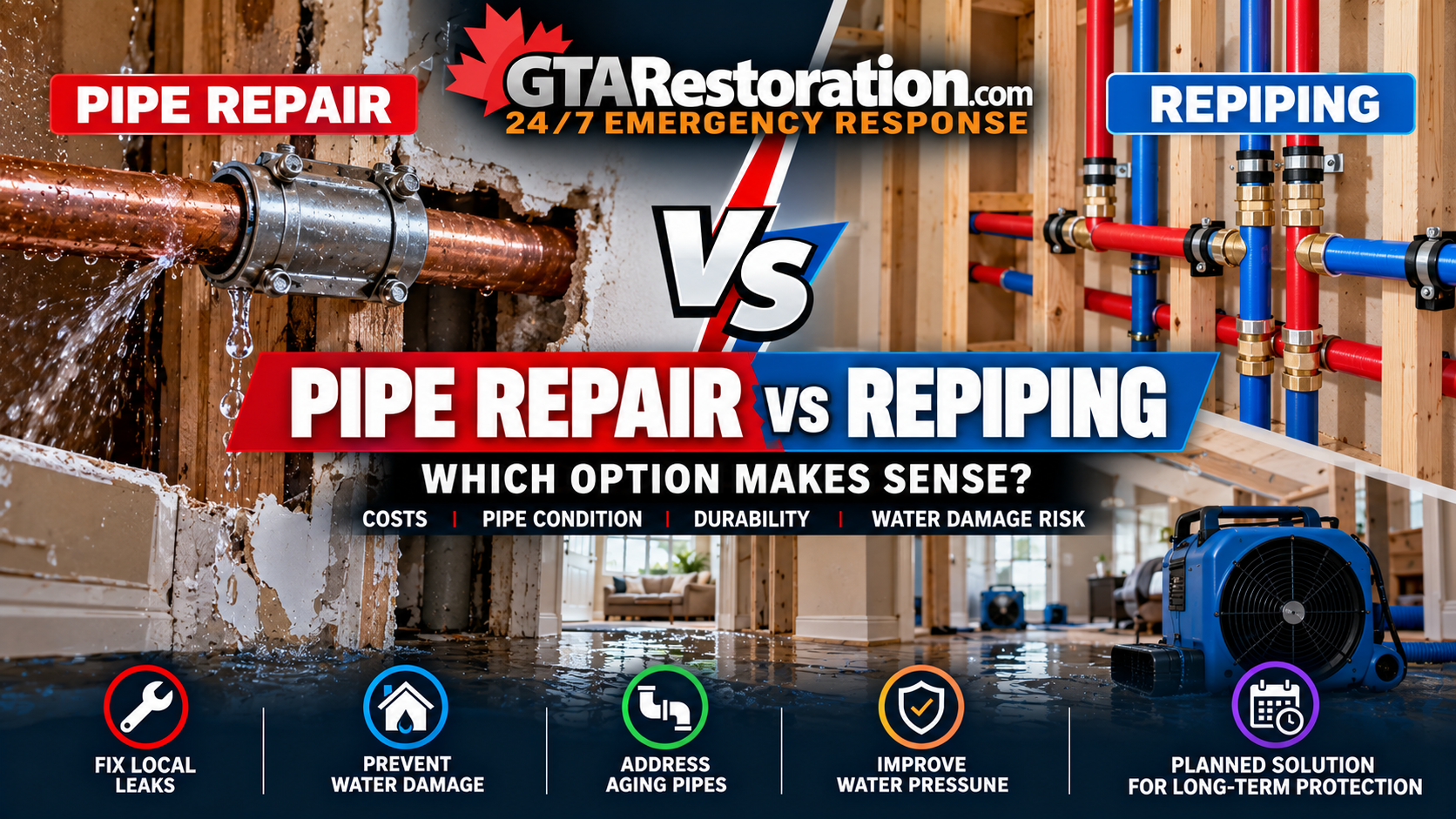
Pipe Repair vs Repiping: Which Fix Protects?


Disaster Restoration Emergency Plumbing Service Blog Icon

A pinhole leak behind a finished wall can look like a small plumbing problem until moisture reaches insulation, flooring, or electrical components. The decision between pipe repair vs repiping affects more than the immediate leak. It can determine whether you stop damage at the source or continue responding to failures throughout an aging plumbing system.

For homeowners, condo owners, landlords, and building operators, the right answer depends on the condition of the pipes, the pattern of failures, accessibility, water quality, and the consequences of another leak. A fast repair is often the right move. In other cases, replacing deteriorated lines is the more controlled and cost-effective way to protect the property.

Pipe Repair vs Repiping: The Core Difference

Pipe repair addresses a specific defect. A licensed plumber may replace a damaged section, repair a joint, install a coupling, or correct a localized issue such as a puncture, failed fitting, or isolated frozen pipe. The goal is to restore service quickly while keeping the existing system in place.

Repiping replaces part or all of a property’s water supply piping. It is typically considered when existing pipes have widespread corrosion, recurring leaks, restricted flow, obsolete materials, or a history of failures in multiple locations. A partial repipe may replace one branch or riser. A whole-home or building-wide repipe replaces the main supply lines and distribution piping more comprehensively.

Neither option is automatically better. The key question is whether the leak is an isolated event or evidence that the plumbing system is nearing the end of its reliable service life.

When a Targeted Pipe Repair Makes Sense

A focused repair is usually appropriate when the rest of the plumbing system is in good condition. For example, a copper pipe may have been damaged during a renovation, a fitting may have failed due to movement, or a frozen line may have split during a severe cold spell. In these cases, replacing the affected section can provide a lasting solution.

Repairs also make sense when a leak is easy to access and there is no pattern of related failures. A visible pipe in an unfinished basement, mechanical room, or utility area can often be repaired with minimal disruption. The cost, downtime, and restoration work are generally much lower than a larger replacement project.

For a newer home or commercial space, one unexpected leak does not necessarily justify repiping. A proper assessment should include the pipe material, age, water pressure, evidence of internal corrosion, and whether nearby piping shows deterioration. The goal is to avoid turning a manageable repair into an unnecessary construction project.

Repairs Are Best for Isolated, Identifiable Problems

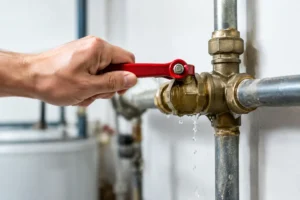
A repair is generally the practical choice when the source is clear and limited. Common examples include a leaking shutoff valve, a cracked section caused by impact, a failed soldered joint, or a single damaged pipe after freezing. Once the source is corrected, the affected area must be tested under pressure and dried thoroughly if water has entered walls, ceilings, or floors.

That last step matters. Stopping the leak does not automatically stop the damage. Wet building materials can support mold growth, cause staining, weaken drywall, and create odors if drying is delayed. In an active water-loss situation, plumbing repair and water damage restoration need to work together.

Signs Repiping May Be the Smarter Investment

Repeated leaks are the clearest warning sign. If one pipe fails this month and another fails across the property a few months later, the issue may be internal corrosion rather than bad luck. Paying for repeated emergency calls, access openings, repairs, drying, and finish restoration can eventually cost more than a planned repiping project.

Water discoloration, metallic-tasting water, reduced pressure, and frequent pinhole leaks can also indicate aging supply lines. Galvanized steel pipes are especially prone to internal corrosion and mineral buildup over time. Older copper systems may develop pinhole leaks depending on water chemistry, installation conditions, and pipe age.

Repiping deserves serious consideration when a property has:

  • Multiple leaks in separate areas over a short period
  • Corroded, galvanized, or otherwise obsolete supply piping
  • Low water pressure that affects several fixtures
  • Visible corrosion, green staining, or recurring wet spots near pipe runs
  • Major renovation plans that will already require opening walls or ceilings

For condo corporations and commercial properties, the decision can be more complex. A vertical riser issue may affect multiple suites or floors, while a failure in a shared mechanical area can interrupt operations for tenants and customers. Planned replacement can reduce the risk of after-hours flooding, tenant disruption, and repeated insurance claims.

Repiping Creates Planned Disruption Instead of Emergency Disruption

Repiping is more invasive than a single repair. Walls or ceilings may need to be opened, fixtures may be temporarily unavailable, and the work requires careful coordination in occupied homes, condos, and commercial buildings. That disruption is real and should be factored into the decision.

However, planned disruption is usually more manageable than emergency disruption. A scheduled project allows the property owner or manager to coordinate access, protect contents, communicate with occupants, and complete restoration in an organized sequence. An unexpected burst pipe rarely offers those advantages.

Material, Age, and Access Change the Decision

The type of pipe matters. Copper, PEX, CPVC, galvanized steel, and other materials have different strengths, typical failure patterns, and expected service lives. A qualified plumbing inspection can identify whether the existing material remains serviceable or whether it has become a growing liability.

Access matters just as much. A small leak in a readily accessible utility room may be repaired quickly. The same leak beneath a finished basement, behind custom cabinetry, or inside a multi-unit building shaft can require significant demolition and restoration. If difficult-to-access pipes have a history of failure, replacing a longer run while access is open may prevent another costly opening later.

Water pressure should also be checked. Excessive pressure can strain pipes, fittings, appliances, and valves, creating repeat leaks even after a repair. Correcting pressure issues or replacing a failed pressure-reducing valve may be part of the long-term solution.

Do Not Ignore the Water Damage Side of a Pipe Failure

A plumbing decision should never be separated from the condition of the building materials around it. Water can travel along framing, behind baseboards, through ceiling cavities, and under flooring before it becomes visible. What appears to be a small supply-line leak can affect a much larger area.

After shutting off the water and repairing the source, the affected area should be inspected with moisture-detection equipment. Professional drying may be needed to remove moisture from structural materials without causing unnecessary demolition. If sewage, gray water, or contaminated water is involved, the cleanup must follow appropriate health and safety procedures rather than relying on surface cleaning alone.

Documentation is also valuable, particularly for insurance claims. Photos, moisture readings, repair details, and records of mitigation work help establish what happened and what was done to prevent further damage.

How to Make the Right Call Before Damage Spreads

Start with a full assessment, not a guess based on the visible leak alone. A plumber should identify the source, inspect nearby lines, evaluate pipe material and condition, and determine whether water pressure or corrosion is contributing to the failure. If water has escaped into the structure, arrange immediate mitigation before moisture creates a larger restoration problem.

For a first, isolated failure in otherwise sound plumbing, repair is often the responsible choice. For recurring leaks, aging or corroded pipe, reduced performance, or failures in difficult-to-access areas, repiping may offer better control over long-term costs and property risk.

When water is actively leaking, speed is critical. Shut off the nearest fixture valve or the main water supply if necessary, move vulnerable contents away from the area, and avoid using electrical equipment near standing water. GTA Restoration can coordinate emergency plumbing, water extraction, drying, and damage documentation so the property is stabilized without forcing you to manage multiple contractors during a stressful event.

The best decision is the one that restores safe water service today while reducing the chance that the next hidden leak becomes tomorrow’s major property loss.

Share this... Spread the word!


Tags:

☛ ☛ Related Restoration Articles You May Also Like!

Emergency? Immediate response 24/7

416.800.0000 416.800.0000

For non-emergencies use our contact form

We Specialize in FAST Restoration Services!


Need Fast Restoration Service? Let our experienced team help. Your satisfaction is our priority.


We Service the GTA with a Fast 45-Minute Response Time!


“FREE VISUAL Estimate”


Restoration & Remediation

Do you need water removal services for your home or business? Are your floors, walls, furniture, or other areas affected by flooding or water damage? GTA Restoration provides professional water removal, drying, cleanup, and restoration services. Acting quickly can help reduce permanent property damage and lower the risk of mold growth. The longer water remains untreated, the greater the potential for additional damage.


Commercial & Residential Property Inspection

GTA Restoration uses professional moisture-detection technology, restoration equipment, and years of industry experience to identify water damage and locate hidden moisture. Specialized equipment allows our technicians to inspect many affected areas without unnecessary demolition, helping determine the extent of the damage before restoration work begins.


Helping You Every Step of the Way!


We understand that situations involving biohazard contamination in your home or business can be difficult and require professional attention. GTA Restoration provides dependable and experienced biohazard cleanup and remediation services for residential and commercial properties. For information about disaster restoration and recovery, visit the disaster restoration resource. For immediate assistance, contact GTA Restoration at (800) 506-6048.


Nationwide, Local Pricing

GTA Restoration offers local flood & water damage repair, mold removal/remediation, asbestos removal/abatement, fire/smoke damage repair services and much more.

Search

  • Ajax Asbestos Removal
  • Ajax Mold Removal
  • Ajax Water Damage
  • Anjou Mold Removal
  • Aurora Mold Removal
  • Aurora Water Damage
  • Beaconsfield Asbestos Removal
  • Beaconsfield Mold Removal
  • Boucherville Mold Removal
  • Brampton Asbestos Removal
  • Brampton Asbestos Removal
  • Brampton Mold Removal
  • Brampton Water Damage
  • Brossard Mold Removal
  • Burlington Asbestos Removal
  • Burlington Mold Removal
  • Burlington Water Damage
  • Burnaby Mold Removal
  • Burst Frozen Pipe Edmonton
  • Caledon Mold Removal
  • Caledon Water Damage
  • Calgary Asbestos Removal
  • Calgary Mold Removal
  • Calgary Water Damage
  • Cambridge Mold Removal
  • Cambridge Water Damage
  • Chambly Mold Removal
  • Chateauguay Mold Removal
  • Chomedey Mold Removal
  • Clarington Mold Removal
  • Concord Mold Removal
  • Concord Water Damage
  • Mississauga Mold Removal
  • Coquitlam Mold Removal
  • Cumberland Mold Removal
  • Dollard-des-Ormeaux Mold Removal
  • Dorval Mold Removal
  • Edmonton Asbestos Removal
  • Edmonton Mold Removal
  • Edmonton Water Damage
  • Etobicoke Asbestos Removal
  • Etobicoke Mold Removal
  • Etobicoke Water Damage
  • McMurray Fire Damage Services
  • Saskatchewan Asbestos Removal
  • Saskatchewan Mold Removal
  • Frozen Burst Pipe Repair Montreal
  • Frozen Burst Pipe Repair Ottawa
  • Gloucester Asbestos Removal
  • Gloucester Mold Removal
  • Hamilton Asbestos Removal
  • Hamilton Asbestos Testing
  • Hamilton Mold Removal
  • Hamilton Water Damage
  • Hampstead Mold Removal
  • Hampstead Water & Flood Damage
  • L'île-Bizard Mold Removal
  • Kahnawake Mold Removal
  • Kanata Asbestos Removal
  • Kanata Mold Removal
  • Kanata Water Damage
  • Kirkland Mold Removal
  • Kitchener Asbestos Removal
  • Kitchener Mold Removal
  • Kitchener Water Damage
  • Lasalle Mold Removal
  • Laval Asbestos Removal
  • Laval Mold Removal
  • Laval Water Damage
  • London Mold Removal
  • London Water Damage
  • Longueuil Mold Removal
  • Longueuil Water Damage
  • Markham Asbestos Removal
  • Markham Mold Removal
  • Markham Water Damage
  • Mississauga Asbestos Testing
  • Mississauga Mold Removal
  • Mississauga Water Damage
  • Montreal Air Duct Cleaning
  • Montreal Asbestos Removal
  • Montreal Asbestos Testing
  • Montreal East Mold Removal
  • Montreal Mold Removal
  • Montreal Water Damage
  • Mount-Royal Mold Removal
  • Nepean Asbestos Removal
  • Nepean Mold Removal
  • Nepean Water Damage
  • New Market Water Damage
  • New Westminster Mold Removal
  • Newmarket Mold Removal
  • North York Mold Removal
  • Oakville Mold Removal
  • Oakville Water Damage
  • Orleans Asbestos Removal
  • Orleans Mold Removal
  • Orleans Water Damage
  • Osgoode Mold Removal
  • Oshawa Mold Removal
  • Oshawa Water Damage
  • Ottawa Air Duct Cleaning
  • Ottawa Asbestos Removal
  • Ottawa Mold Removal
  • Ottawa Vermiculite Removal
  • Ottawa Water Damage
  • Pickering Mold Removal
  • Pickering Water Damage
  • Red Deer Mold Removal
  • Red Deer Water Damage
  • Richmond Hill Mold Removal
  • Richmond Hill Water Damage
  • Richmond Mold Removal
  • Rideau Lakes Mold Removal
  • Rockcliffe Park Mold Removal
  • Roxboro Mold Removal
  • Saint Laurent Mold Removal
  • Saint-Hubert Mold Removal
  • Scarborough Asbestos Removal
  • Scarborough Mold removal
  • Scarborough Water Damage
  • Sewer Backup Edmonton
  • Sewer Backup Montreal
  • Sewer Backup Ottawa
  • Sherwood Park Asbestos Removal
  • Sherwood Park Mold Removal
  • Spruce Grove Asbestos Removal
  • Spruce Grove Mold Removal
  • St. Albert Asbestos Removal
  • St. Albert Mold Removal
  • Ste.Dorothee Mold Removal
  • Surrey Mold Removal
  • Thornhill Mold Removal
  • Toronto & GTA Asbestos Removal
  • Toronto & GTA Mold Removal
  • Toronto Air Duct Cleaning
  • Toronto Water Damage
  • Unionville Mold Removal
  • Unionville Water Damage
  • Vancouver Asbestos Removal
  • Vancouver Mold Removal
  • Vancouver Water Damage
  • Vanier Mold Removal
  • Vaughan Mold Removal
  • Vaughan Water Damage
  • Westmount Mold Removal
  • Whitby Water Damage
  • Woodbridge Asbestos Removal
  • Woodbridge Mold Removal
  • Woodbridge Water Damage
  • Waterproofing
  • Kitchen & Bath Pro
  • Condo Restoration

Main Head Office


For Tips on Water Damage and Emergency Plumbing


We Work Direct with All Insurance Companies

Wᴇ ᴀʀᴇ ᴄᴏᴍᴍɪᴛᴛᴇᴅ ᴏɴ ᴡᴏʀᴋɪɴɢ ᴡɪᴛʜ ᴇᴠᴇʀʏ ɪɴsᴜʀᴀɴᴄᴇ ᴄᴏᴍᴘᴀɴʏ ᴀᴄʀᴏss Cᴀɴᴀᴅᴀ & USA.


In House Financing Available

In House Financing Available

FREE Financing Up To 24 Months NO INTEREST NO MONEY DOWN


Contact Us

Learn more ↴ GTA Restoration Tips

RELATED ARTICLES

  • How To Avoid Sprinkler Water Damage?
  • How To Deal With Floods & Water Damage?
  • Signs of Mould Growth In Your Property?
  • Avoid Mould Damage from Melting Snow
  • How to Prevent Water Damage In Summer
  • Avoid Mold Growth With Proper Air Flow
  • Prevent House Floods from Spring Rains
  • Prevent Frozen Burst Pipes in Winter
  • What To Do on Your Flooded Basement?


follow us on  LinkedIn Instagram Twitter Facebook YouTube


Our Clients

Our Vendor Clients


Affiliates

fully certified


GTA Restoration Toronto

Copyright © 2009 - 2026 All Rights Reserved. Sitemap/Links

LinkedInInstagram Twitter Facebook YouTube

Call Us 416-800-0000

Emergency? Immediate response 24/7

416.800.0000

416.800.0000

We cover all GTA 24/7.

Head Office:
250 Consumers Rd,
#10
Toronto, ON
M2J 4V6,
Open 24 hours

Downtown Office:
1 Toronto St,
#10
Toronto, ON
M5W 1A1,
Open 24 hours

For non-emergencies use our contact form


    Not sure what you need?

    Call us today to find the best product for your situation.

    416-800-0000 416-800-0000

    Head Office:
    101 Lebovic Ave,
    Unit #10
    Scarborough,
    ON, M1L 4T7
    Hours
    24-Hours Open

    Downtown Office:
    250 Yonge Street,
    Unit #1A
    Toronto,
    ON, M5B 2L7
    Hours
    24-Hours Open

    Pipe Repair vs Repiping: Which Fix Protects?

    Get a quote today


      GTA Restoration Assistant 24/7 Emergency Restoration Help
      Hi! I'm GTA Restoration's virtual assistant. How can I help with your property damage today?
      Emergency? Call 416-800-0000