...
Mold Removal and Mould Remediation Toronto - GTA Restoration

Emergency? 24-Hrs

416.800.0000
  • Home Restore
  • Emergency Services
    • Emergency Plumbers 24/7
    • Water Damage Restoration
    • Flooded Basement Cleanup
    • Mold Remediation Toronto
    • Sewer Backup Remediation
    • Fire & Smoke Restoration
    • Odour Removal Toronto
    • Biohazard & Crime Scene Cleanup
    • Emergency Roofing Repair
    • Water Leak and Detection
    • Condominium Restoration
    • Basement WaterProofing
    • Property Inspection Toronto
    • Sanitizing and Disinfection
    • Insurance Claim Appraisers
    • Equipment for Rent Toronto
    • Privacy Policy & Service Terms
  • Commercial Restoration
  • Blog
    • All Blog Articles
    • Video Library
  • Our Team
  • Contact
13 September 2026 - Categories:

Office Fire Restoration Example That Reopens Fast


Disaster Restoration Emergency Plumbing Service Blog Icon

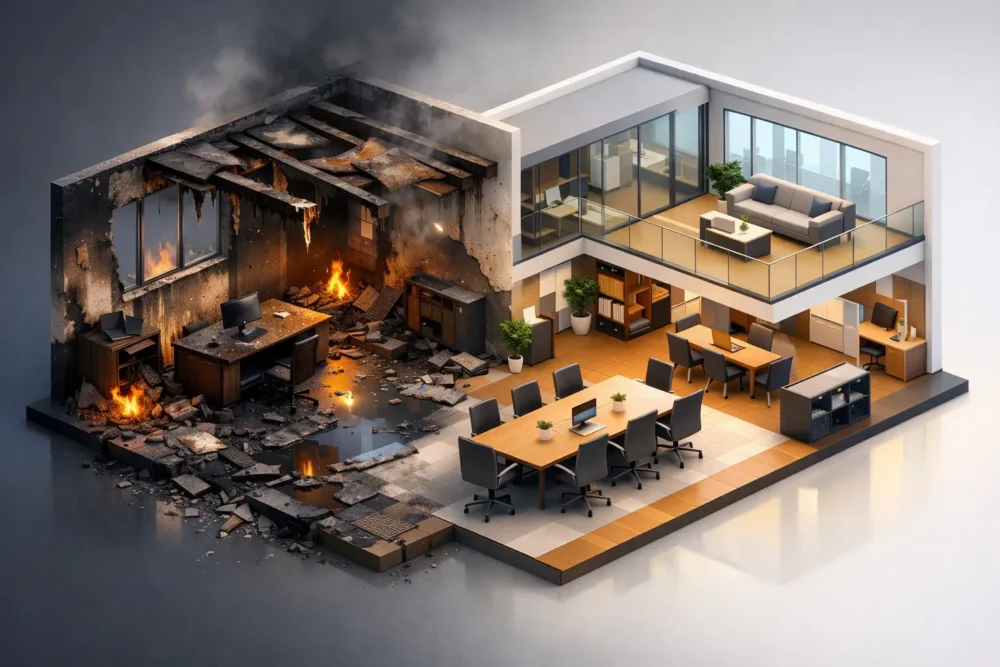
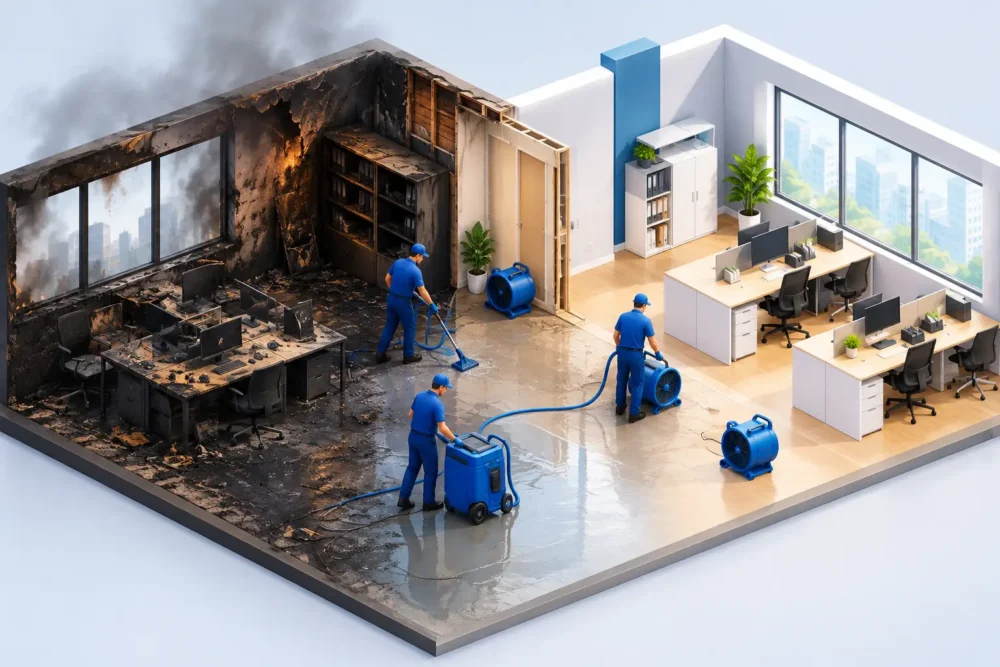
A fire in an office does not have to destroy the entire business to stop operations. A small electrical fire in a break room, server closet, or reception area can spread smoke and corrosive soot through ventilation pathways in minutes. This office fire restoration example shows what a controlled, safety-first recovery can look like when the priority is protecting people, preserving assets, and getting the workplace ready to reopen.

Consider a mid-sized professional office in the GTA with 35 employees. A microwave circuit failure causes a contained fire after hours. Sprinklers activate, the fire department extinguishes the remaining flames, and the direct burn damage is limited to one room. By morning, however, the building has fire residue, sprinkler water, smoke odor, wet ceiling tiles, and critical electronics exposed to soot. The office cannot simply be aired out and reopened.

The first hours: Secure the office and stop secondary damage

Once fire officials release the site, the restoration process begins with stabilization. This is not cosmetic cleanup. Fire residues can be acidic and corrosive, water can migrate under flooring and into wall cavities, and damaged electrical systems may create an ongoing hazard.

The restoration team starts by documenting conditions with photos, moisture readings, thermal imaging, and a room-by-room inventory of affected materials. That documentation supports the insurance claim and establishes a clear scope of work before materials are removed or cleaned.

At the same time, technicians isolate the affected area, assess electrical risks, and arrange emergency power or temporary protection where needed. Commercial-grade air scrubbers with HEPA filtration are installed to capture airborne particulate. Dehumidifiers and air movers address sprinkler water before it feeds mold growth, delaminates flooring, or damages the suite below.

For a property manager, fast stabilization also means communication. Building management, the insurer, tenants, and any affected neighboring units need clear updates on access restrictions, safety conditions, and the anticipated recovery sequence. Uncertainty creates downtime. A documented plan gives decision-makers something concrete to act on.

Office fire restoration example: Finding damage beyond the flames

The visible burn area is rarely the full scope of an office fire. In this example, the break room has charred cabinetry, damaged drywall, and a compromised ceiling grid. Yet the more extensive work is found elsewhere: smoke has traveled through the return-air system, soot has settled in open workstations, and water has reached carpet tiles in the hallway and reception area.

This is why a professional assessment matters. A technician may use particle monitoring, moisture mapping, odor tracing, and inspection of HVAC components to determine where contaminants traveled. Porous materials such as ceiling tiles, insulation, heavily affected carpet, and paper records may require removal. Nonporous surfaces, furniture, glass, metal fixtures, and some electronics may be cleaned and restored when their condition permits.

The decision to clean or replace depends on contamination level, material type, cost, and whether the item can be returned to a safe, odor-free condition. For example, a lightly affected metal filing cabinet can often be detailed and deodorized. A waterlogged particleboard desk with embedded smoke odor may be more practical to replace. Trying to save every item can delay reopening and sometimes costs more than targeted replacement.

Electronics need specialized attention

Computers, network switches, printers, AV equipment, and servers can be damaged by soot even when they were not directly burned. Fine residues may interfere with cooling fans, circuit boards, and connections. Staff should not power up affected equipment until it has been inspected and, where appropriate, cleaned by qualified specialists.

In this scenario, the office’s server closet is outside the fire room but shares an air return path. The restoration team coordinates containment and detailed cleaning while the business transitions essential operations to secured cloud backups and temporary devices. That coordination can prevent a property incident from becoming a longer business continuity failure.

Cleaning, deodorization, and water recovery happen together

Fire recovery often requires several processes at once. Waiting for one trade to finish before starting the next can extend downtime, especially in an occupied commercial building. A full-service restoration provider can coordinate cleaning, drying, debris removal, plumbing-related repairs, and reconstruction under one recovery plan.

Technicians use the cleaning method that fits the surface and residue. Dry soot may require HEPA vacuuming and specialized dry-cleaning sponges. Wet or greasy residues may require controlled wet cleaning with appropriate products. The objective is not to mask smoke odor with fragrance. It is to remove the residue causing the odor and treat affected materials, cavities, and HVAC pathways.

In the sample office, the team removes the damaged break room finishes, cleans hard surfaces throughout the suite, and uses controlled deodorization after source removal. Meanwhile, moisture equipment continues operating in the reception area and corridor. Daily moisture readings confirm that concealed materials are drying as expected.

This stage is especially important where sprinklers have discharged. Fire and water damage are connected, but they do not follow the same rules. Soot calls for containment and detailed cleaning; water requires extraction, drying verification, and sometimes selective demolition. Addressing only what is visible can leave odor, corrosion, mold risk, and insurance complications behind.

Rebuilding around business continuity

The office does not need to remain fully closed until every repair is complete. In many cases, phased restoration can safely return part of the space to service while reconstruction continues in contained areas.

For this office, staff temporarily work from a cleaned conference area and remote locations while the break room and a section of the hallway are sealed off for repairs. Damaged drywall, ceiling tiles, flooring, cabinetry, and electrical components are replaced. HVAC components are inspected and cleaned before normal operation resumes.

A phased plan works when safe access, indoor air conditions, noise, dust control, and code requirements are managed properly. It may not work after a large fire, major structural damage, widespread electrical impact, or severe smoke migration. In those cases, temporary relocation may be the safer and more efficient choice.

Commercial reconstruction should also consider improvements that reduce future disruption. That may include replacing vulnerable finishes with easier-to-clean materials, improving fire stopping around penetrations, updating damaged plumbing connections, or correcting electrical issues identified during the fire investigation. These choices should be made with the building owner, tenant, insurer, and applicable code requirements in mind.

Insurance documentation protects the claim and the schedule

A well-managed claim is not just paperwork. It keeps approvals, cleaning decisions, and repair work moving. The restoration team should provide a detailed scope, photo documentation, equipment records, moisture logs, contents inventory, and clear estimates for emergency services and rebuilding work.

For the office manager in this example, documentation distinguishes fire-damaged property from items affected by sprinkler water or smoke. It also records emergency mitigation work that prevented additional loss. This level of detail helps adjusters evaluate the claim and gives the business a record of what was removed, cleaned, restored, or replaced.

GTA Restoration coordinates fire, smoke, water, odor, and reconstruction work so commercial clients are not forced to manage separate emergency contractors while their office is offline. The goal is a controlled path from initial site stabilization to a clean, safe workspace ready for employees and customers.

What office managers should do after a fire

Do not re-enter until fire officials and building management confirm it is safe. Avoid touching soot-covered surfaces or turning on equipment that may have been exposed to heat, water, or residue. Preserve receipts, take initial photos if it is safe to do so, and notify your insurer promptly.

Then call a qualified fire restoration team for immediate assessment. Early containment, water extraction, and residue control can make the difference between cleaning a recoverable office and facing a much larger reconstruction project.

A successful office recovery is measured by more than repaired walls. It is measured by safe air, protected records and equipment, accurate claim documentation, and a workplace your team can return to with confidence.

Share this... Spread the word!


Tags:

☛ ☛ Related Restoration Articles You May Also Like!

Emergency? Immediate response 24/7

416.800.0000 416.800.0000

For non-emergencies use our contact form
We Specialize in FAST Restoration Services!


Need Fast Restoration Service? Let our experienced team help. Your satisfaction is our priority.


We Service the GTA with a Fast 45-Minute Response Time!


“FREE VISUAL Estimate”


Restoration & Remediation

Do you need water removal services for your home or business? Are your floors, walls, furniture, or other areas affected by flooding or water damage? GTA Restoration provides professional water removal, drying, cleanup, and restoration services. Acting quickly can help reduce permanent property damage and lower the risk of mold growth. The longer water remains untreated, the greater the potential for additional damage.


Commercial & Residential Property Inspection

GTA Restoration uses professional moisture-detection technology, restoration equipment, and years of industry experience to identify water damage and locate hidden moisture. Specialized equipment allows our technicians to inspect many affected areas without unnecessary demolition, helping determine the extent of the damage before restoration work begins.


Helping You Every Step of the Way!


We understand that situations involving biohazard contamination in your home or business can be difficult and require professional attention. GTA Restoration provides dependable and experienced biohazard cleanup and remediation services for residential and commercial properties. For information about disaster restoration and recovery, visit the disaster restoration resource. For immediate assistance, contact GTA Restoration at (800) 506-6048.


Nationwide, Local Pricing

GTA Restoration offers local flood & water damage repair, mold removal/remediation, asbestos removal/abatement, fire/smoke damage repair services and much more.

Search

  • Ajax Asbestos Removal
  • Ajax Mold Removal
  • Ajax Water Damage
  • Anjou Mold Removal
  • Aurora Mold Removal
  • Aurora Water Damage
  • Beaconsfield Asbestos Removal
  • Beaconsfield Mold Removal
  • Boucherville Mold Removal
  • Brampton Asbestos Removal
  • Brampton Asbestos Removal
  • Brampton Mold Removal
  • Brampton Water Damage
  • Brossard Mold Removal
  • Burlington Asbestos Removal
  • Burlington Mold Removal
  • Burlington Water Damage
  • Burnaby Mold Removal
  • Burst Frozen Pipe Edmonton
  • Caledon Mold Removal
  • Caledon Water Damage
  • Calgary Asbestos Removal
  • Calgary Mold Removal
  • Calgary Water Damage
  • Cambridge Mold Removal
  • Cambridge Water Damage
  • Chambly Mold Removal
  • Chateauguay Mold Removal
  • Chomedey Mold Removal
  • Clarington Mold Removal
  • Concord Mold Removal
  • Concord Water Damage
  • Mississauga Mold Removal
  • Coquitlam Mold Removal
  • Cumberland Mold Removal
  • Dollard-des-Ormeaux Mold Removal
  • Dorval Mold Removal
  • Edmonton Asbestos Removal
  • Edmonton Mold Removal
  • Edmonton Water Damage
  • Etobicoke Asbestos Removal
  • Etobicoke Mold Removal
  • Etobicoke Water Damage
  • McMurray Fire Damage Services
  • Saskatchewan Asbestos Removal
  • Saskatchewan Mold Removal
  • Frozen Burst Pipe Repair Montreal
  • Frozen Burst Pipe Repair Ottawa
  • Gloucester Asbestos Removal
  • Gloucester Mold Removal
  • Hamilton Asbestos Removal
  • Hamilton Asbestos Testing
  • Hamilton Mold Removal
  • Hamilton Water Damage
  • Hampstead Mold Removal
  • Hampstead Water & Flood Damage
  • L'île-Bizard Mold Removal
  • Kahnawake Mold Removal
  • Kanata Asbestos Removal
  • Kanata Mold Removal
  • Kanata Water Damage
  • Kirkland Mold Removal
  • Kitchener Asbestos Removal
  • Kitchener Mold Removal
  • Kitchener Water Damage
  • Lasalle Mold Removal
  • Laval Asbestos Removal
  • Laval Mold Removal
  • Laval Water Damage
  • London Mold Removal
  • London Water Damage
  • Longueuil Mold Removal
  • Longueuil Water Damage
  • Markham Asbestos Removal
  • Markham Mold Removal
  • Markham Water Damage
  • Mississauga Asbestos Testing
  • Mississauga Mold Removal
  • Mississauga Water Damage
  • Montreal Air Duct Cleaning
  • Montreal Asbestos Removal
  • Montreal Asbestos Testing
  • Montreal East Mold Removal
  • Montreal Mold Removal
  • Montreal Water Damage
  • Mount-Royal Mold Removal
  • Nepean Asbestos Removal
  • Nepean Mold Removal
  • Nepean Water Damage
  • New Market Water Damage
  • New Westminster Mold Removal
  • Newmarket Mold Removal
  • North York Mold Removal
  • Oakville Mold Removal
  • Oakville Water Damage
  • Orleans Asbestos Removal
  • Orleans Mold Removal
  • Orleans Water Damage
  • Osgoode Mold Removal
  • Oshawa Mold Removal
  • Oshawa Water Damage
  • Ottawa Air Duct Cleaning
  • Ottawa Asbestos Removal
  • Ottawa Mold Removal
  • Ottawa Vermiculite Removal
  • Ottawa Water Damage
  • Pickering Mold Removal
  • Pickering Water Damage
  • Red Deer Mold Removal
  • Red Deer Water Damage
  • Richmond Hill Mold Removal
  • Richmond Hill Water Damage
  • Richmond Mold Removal
  • Rideau Lakes Mold Removal
  • Rockcliffe Park Mold Removal
  • Roxboro Mold Removal
  • Saint Laurent Mold Removal
  • Saint-Hubert Mold Removal
  • Scarborough Asbestos Removal
  • Scarborough Mold removal
  • Scarborough Water Damage
  • Sewer Backup Edmonton
  • Sewer Backup Montreal
  • Sewer Backup Ottawa
  • Sherwood Park Asbestos Removal
  • Sherwood Park Mold Removal
  • Spruce Grove Asbestos Removal
  • Spruce Grove Mold Removal
  • St. Albert Asbestos Removal
  • St. Albert Mold Removal
  • Ste.Dorothee Mold Removal
  • Surrey Mold Removal
  • Thornhill Mold Removal
  • Toronto & GTA Asbestos Removal
  • Toronto & GTA Mold Removal
  • Toronto Air Duct Cleaning
  • Toronto Water Damage
  • Unionville Mold Removal
  • Unionville Water Damage
  • Vancouver Asbestos Removal
  • Vancouver Mold Removal
  • Vancouver Water Damage
  • Vanier Mold Removal
  • Vaughan Mold Removal
  • Vaughan Water Damage
  • Westmount Mold Removal
  • Whitby Water Damage
  • Woodbridge Asbestos Removal
  • Woodbridge Mold Removal
  • Woodbridge Water Damage
  • Waterproofing
  • Kitchen & Bath Pro
  • Condo Restoration

Main Head Office


For Tips on Water Damage and Emergency Plumbing


We Work Direct with All Insurance Companies

Wᴇ ᴀʀᴇ ᴄᴏᴍᴍɪᴛᴛᴇᴅ ᴏɴ ᴡᴏʀᴋɪɴɢ ᴡɪᴛʜ ᴇᴠᴇʀʏ ɪɴsᴜʀᴀɴᴄᴇ ᴄᴏᴍᴘᴀɴʏ ᴀᴄʀᴏss Cᴀɴᴀᴅᴀ & USA.


In House Financing Available

In House Financing Available

FREE Financing Up To 24 Months NO INTEREST NO MONEY DOWN


Contact Us

Learn more ↴ GTA Restoration Tips

RELATED ARTICLES

  • How To Avoid Sprinkler Water Damage?
  • How To Deal With Floods & Water Damage?
  • Signs of Mould Growth In Your Property?
  • Avoid Mould Damage from Melting Snow
  • How to Prevent Water Damage In Summer
  • Avoid Mold Growth With Proper Air Flow
  • Prevent House Floods from Spring Rains
  • Prevent Frozen Burst Pipes in Winter
  • What To Do on Your Flooded Basement?


follow us on  LinkedIn Instagram Twitter Facebook YouTube


Our Clients

Our Vendor Clients


Affiliates

fully certified


GTA Restoration Toronto

Copyright © 2009 - 2026 All Rights Reserved. Sitemap/Links

LinkedInInstagram Twitter Facebook YouTube

Call Us 416-800-0000

Emergency? Immediate response 24/7

416.800.0000

416.800.0000

We cover all GTA 24/7.

Head Office:
250 Consumers Rd,
#10
Toronto, ON
M2J 4V6,
Open 24 hours

Downtown Office:
1 Toronto St,
#10
Toronto, ON
M5W 1A1,
Open 24 hours

For non-emergencies use our contact form


    Not sure what you need?

    Call us today to find the best product for your situation.

    416-800-0000 416-800-0000

    Head Office:
    101 Lebovic Ave,
    Unit #10
    Scarborough,
    ON, M1L 4T7
    Hours
    24-Hours Open

    Downtown Office:
    250 Yonge Street,
    Unit #1A
    Toronto,
    ON, M5B 2L7
    Hours
    24-Hours Open

    Office Fire Restoration Example That Reopens Fast

    Get a quote today


      GTA Restoration Assistant 24/7 Emergency Restoration Help
      Hi! I'm GTA Restoration's virtual assistant. How can I help with your property damage today?
      Emergency? Call 416-800-0000